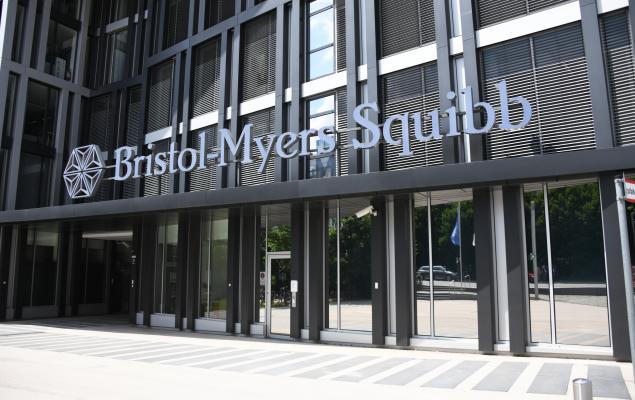
Bristol Myers Squibb received European Commission approval to expand Breyanzi (lisocabtagene maraleucel) for adults with relapsed/refractory mantle cell lymphoma after ≥2 prior therapies including a BTK inhibitor, based on TRANSCEND NHL 001 MCL cohort data showing an 82.7% overall response rate, 71.6% complete response rate and 50.8% of patients still in response at 24 months. The approval supports diversification amid generic pressure on Revlimid, Pomalyst, Sprycel and Abraxane; BMY shares rose on related industry data (Bayer asundexian) despite a year-to-date decline of 15.6%. Separately, BMY and J&J halted the Librexia ACS milvexian trial after an IDMC interim review but will continue two other late-stage milvexian studies with topline data expected in 2026.
Market structure: Bristol Myers (BMY) is the clear direct beneficiary of the EU label expansion for Breyanzi — it strengthens BMY's differentiated CAR‑T franchise versus legacy small‑molecule franchises that are losing Revlimid/Pomalyst revenue to generics. Near‑term share gains will be driven by sentiment and prescriber interest, but commercial upside is constrained by manufacturing capacity and payer negotiation in major EU markets (addressable patients likely in the low‑thousands/year), so pricing power is moderate not unlimited.
Risk assessment: Tail risks include regulatory/payer pushback on CAR‑T pricing, severe toxicity headlines, or further late‑stage milvexian failures (Librexia ACS already stopped) that impair cardiovascular upside; each could knock 15–30% off consensus BMY upside. Time horizons: days–weeks = sentiment moves (earnings, national HTA decisions), months = early commercial uptake/reimbursement, 12–24 months = measurable revenue offset to generic erosion. Hidden dependencies are hospital site capacity, CD19 manufacturing yields, and JNJ partnership execution for milvexian readouts (key catalysts in 2026).
Trade implications: For directional exposure take a modest long: 2–3% portfolio weight in BMY equity, target +20–30% over 12 months, stop‑loss at −12%. If you prefer defined risk, buy a 12–18 month BMY call spread (debit) sized to equal ~1–2% notional. Hedge clinically: buy 1‑year 10% OTM puts equal to half your long to protect vs trial/regulatory shocks. Consider a small pair trade (long BMY 1% / short JNJ 1%) to express differentiated pipeline optionality while limiting market beta.
Contrarian angles: Consensus underestimates commercial friction — approvals create value but not instant replacement for flagship loss; market may be underpricing slower ramp and overpricing milvexian binary risk. Historical parallel: CAR‑T launches (Kite/GILD) showed multi‑quarter sales ramps and reimbursement negotiations that capped early profitability. If you expect rapid, large revenue gains you may be exposed to a 6–12 month correction when real sales numbers arrive.
AI-powered research, real-time alerts, and portfolio analytics for institutional investors.
Request DemoOverall Sentiment
mildly positive
Sentiment Score
0.25
Ticker Sentiment
