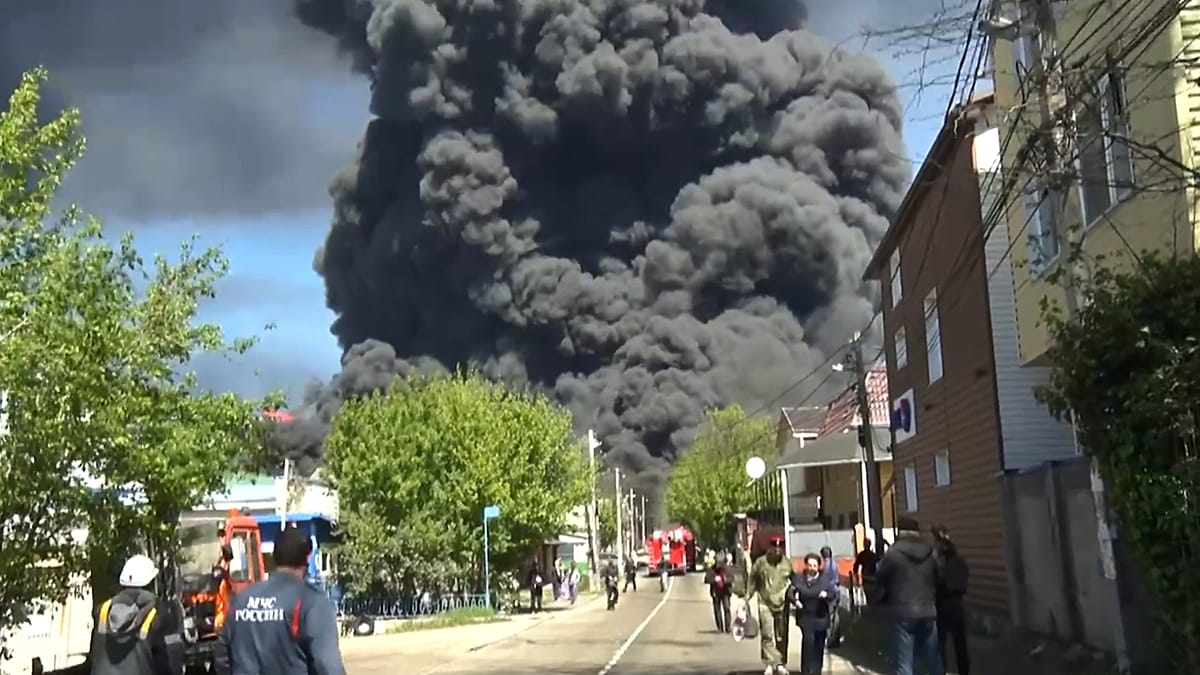
Ukraine’s overnight strikes set fire to the Sloviansk refinery in southern Russia, which processes close to 4 million tons of crude per year, and killed one person. Putin acknowledged for the first time that Russia is facing a fuel deficit and said the government will raise fuel imports, speed repairs, and strengthen protection of oil facilities, including faster output of air defense systems. The attacks are intensifying pressure on Russian energy infrastructure, worsening fuel shortages and potentially disrupting export flows through Black Sea ports.
The market should treat this less as a one-off headline and more as a compounding logistics shock to a system that already runs with thin buffers. The key second-order effect is not just higher retail fuel prices inside Russia, but a widening wedge between refined-product export capacity and domestic supply, which can force policy responses that are margin-destructive for producers: export curbs, price controls, forced rerouting, and higher state intervention in distribution. That combination tends to compress realized product pricing even if crude stays firm, and it raises the probability that inland transport and marine fuel availability become bottlenecks for regional commerce.
The most interesting transmission is to Black Sea flows and regional shipping economics. If refinery outages persist into weeks rather than days, expect tighter availability of fuel oil, naphtha, and marine bunker supplies around the Black Sea basin, which can lift freight and bunkering costs for non-Russian counterparties while reducing arbitrage opportunities for traders who depend on those grades. This also matters for defense and infrastructure equities: repeated strikes force incremental spending into air defense, hardening, and repair, but those are lagged capex items, whereas the production hit is immediate, so the near-term economic effect is asymmetric.
The downside tail is escalation through persistence, not single-event damage. A sustained campaign over 1-3 months could pressure Russian logistics enough to alter military tempo and trigger broader fuel rationing, but that same pressure may also accelerate forced imports and faster repairs, blunting the trade if weather, repair capacity, or air defense improves. The contrarian point: the initial market reaction may overstate global refined-product tightness, because Russia can redirect some crude barrels and domestic demand destruction can partially offset export disruptions; the bigger opportunity is in relative value, not outright energy beta.
AI-powered research, real-time alerts, and portfolio analytics for institutional investors.
Request DemoOverall Sentiment
strongly negative
Sentiment Score
-0.65
Ticker Sentiment
