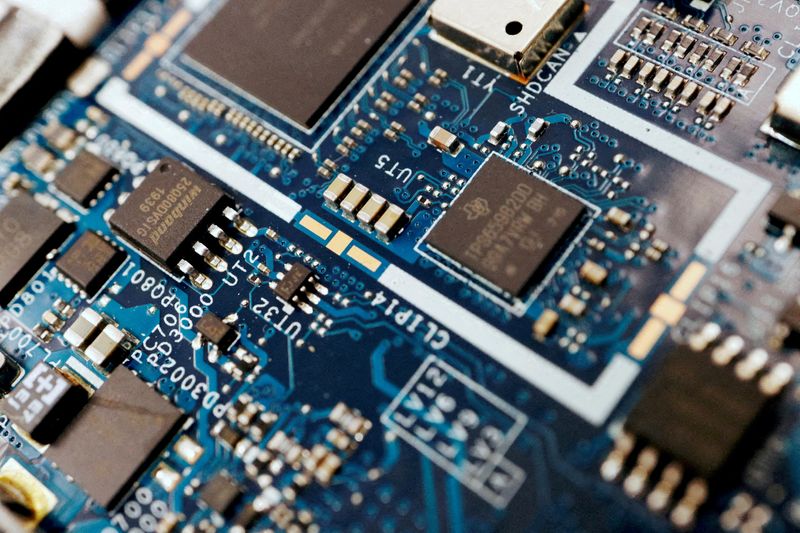
Moore Threads swung to a first-quarter profit of 29.4 million yuan, versus a 112.5 million yuan loss a year earlier, as revenue jumped 155% year-on-year to 737.6 million yuan on strong AI-related chip demand. Shares rose as much as 12.8% to 720 yuan, their highest since Dec. 2025, as the company benefits from China’s push for semiconductor self-sufficiency. The results also highlight ongoing demand for domestic AI chips amid U.S. export restrictions on advanced Nvidia products to China.
This is less a single-name earnings story than an early signal that China’s domestic AI capex cycle is broadening beyond data-center servers into local silicon, packaging, and power/thermal infrastructure. If domestic GPU vendors can monetize demand at scale, the first-order winner is the Chinese AI stack, but the second-order loser is the import substitution premium previously embedded in offshore AI leaders’ China exposure. For NVDA, the implication is not immediate revenue collapse; it is a slower burn on a market that was already capped by export controls, meaning incremental upside from China re-opening narratives is now harder to underwrite.
The key read-through is competitive intensity, not share loss. Domestic chip momentum can pull forward procurement from system integrators, cloud providers, and AI labs that need compliant capacity quickly, which may compress pricing power across the broader China AI hardware ecosystem. That dynamic can also benefit non-NVDA suppliers of memory, substrates, optics, and foundry-adjacent equipment if domestic vendors scale production faster than expected, but it raises execution risk: many “profit” inflections in this segment can reverse quickly if government orders normalize or inventory builds outrun real end demand.
For NVDA, the negative data point is mostly on the terminal value of China as an optionality market; the earnings base remains driven by ex-China hyperscalers. The more interesting trade is that domestic Chinese GPU strength can become self-defeating for the sector if it triggers subsidy-driven overcapacity, leading to pricing pressure and margin resets over the next 2-4 quarters. If that happens, the market will likely re-rate from “AI scarcity” to “AI industrial policy,” which is a lower-multiple regime.
AI-powered research, real-time alerts, and portfolio analytics for institutional investors.
Request DemoOverall Sentiment
strongly positive
Sentiment Score
0.72
Ticker Sentiment
