


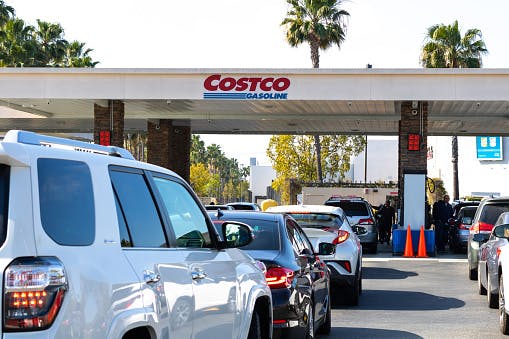
Costco reported mixed fiscal Q3 results: revenue missed consensus at $69.2 billion versus $69.6 billion expected, while adjusted EPS of $4.93 and membership fees of $1.37 billion both slightly topped estimates. The revenue shortfall suggests softer consumer spending even as higher gas prices may have provided some lift. Shares were flat after hours, indicating a limited but notable reaction.
The read-through is less about one company and more about a bifurcation in discretionary demand: value-oriented, membership-driven traffic is holding up at the low end, while basket expansion and higher-ticket categories are still soft. That matters because Costco is usually treated as the cleanest consumer-health barometer; a miss there suggests the next leg of the retail tape may be driven more by company-specific execution than by a broad reacceleration in spending. In that context, the sharp relative strength in BBY and DLTR looks more like a relief rally than confirmation of durable demand improvement.
Second-order, Costco’s model can partially hide demand weakness through mix: fuel, fees, and traffic density can cushion the top line even when merchandise spend disappoints. If gas remains elevated, the company can post resilient optics without necessarily signaling stronger discretionary purchasing power, which limits how bullish investors should be on the print. Conversely, if fuel normalizes, the same earnings quality buffer fades quickly and the market may reprice the name back toward a pure traffic-and-ticket story over the next 1-2 quarters.
The contrarian setup is that COST may be the highest-quality short among consumer staples/retail if investors are extrapolating premium multiple support from a resilient membership narrative. The stock already has crowded ownership and a strong year-to-date gain, so even a modest deceleration in comp momentum can compress the premium multiple faster than fundamentals deteriorate. That makes downside in COST asymmetric if management cannot reaccelerate non-fuel sales into the next report.
For BBY and DLTR, the better signal is not the one-day pop but whether this is the start of a trade-down rotation that persists for several months. If weaker consumer confidence is translating into more dollar-store traffic and more value-seeking electronics purchases, these names could keep outperforming even without broad retail strength. If not, the post-earnings move will likely fade as investors refocus on margin pressure and promotions.
AI-powered research, real-time alerts, and portfolio analytics for institutional investors.
Request TrialOverall Sentiment
neutral
Sentiment Score
-0.05
Ticker Sentiment
