
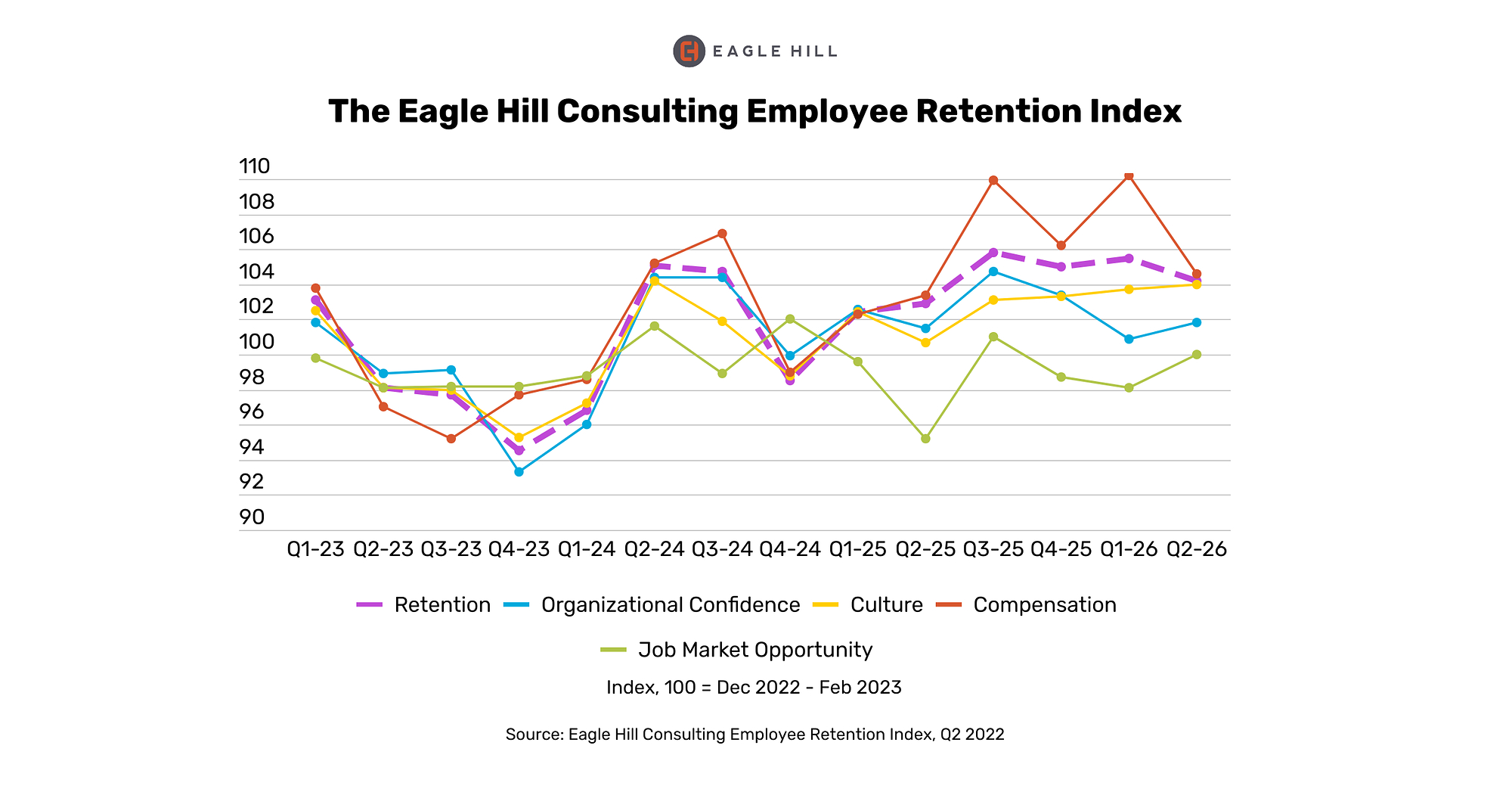
Eagle Hill Consulting’s Employee Retention Index declined modestly, with the Compensation Indicator down 5.6 points (only weakening driver), while the Job Market Opportunity Indicator rose 1.9 points, signaling improving external prospects. The labor backdrop is mixed: JOLTS job openings held steady at 7.6 million (above expectations) as hiring slowed in the June jobs report, suggesting a cooling labor market that still offers opportunities. The sharpest shift is among Millennials, with a 6.1-point retention drop, raising near-term turnover risk despite improving organizational confidence and culture (+0.9 and +0.3 points, respectively).
This reads less like a broad labor-market deterioration and more like a selective retention problem centered on comp compression. The first-order impact is on companies with high reliance on experienced, client-facing, or billable talent: turnover shows up first in recruiting and training costs, then in slower delivery, worse service quality, and delayed revenue recognition over the next 1-2 quarters. The more exposed names are not necessarily the highest headcount employers, but the ones where losing one mid-level manager can disrupt a whole revenue team.
The clearest beneficiaries are vendors that monetize employee friction: payroll, compensation management, internal mobility, and recruiting workflows. That argues for a mild positive read-through to PAYC/ADP-type software and to staffing/recruiting intermediaries if churn actually rises, but the hiring slowdown caps the upside for pure placement businesses. The better expression is software that helps employers defend retention, not cyclicals that need outright headcount growth.
Contrarian view: the market may be overreacting to a survey that is more about relative pay expectations than macro labor stress. Culture and organizational confidence improving at the same time suggests this is not a collapse in employee engagement, just a narrowing gap between current pay and outside alternatives. Falsifiers are straightforward: if openings roll over, quits fall, or wage growth decelerates again, this becomes a non-event; if not, expect a 3-6 month margin headwind for labor-intensive services before it becomes a broader inflation story.
AI-powered research, real-time alerts, and portfolio analytics for institutional investors.
Request TrialOverall Sentiment
mildly negative
Sentiment Score
-0.25
Ticker Sentiment
