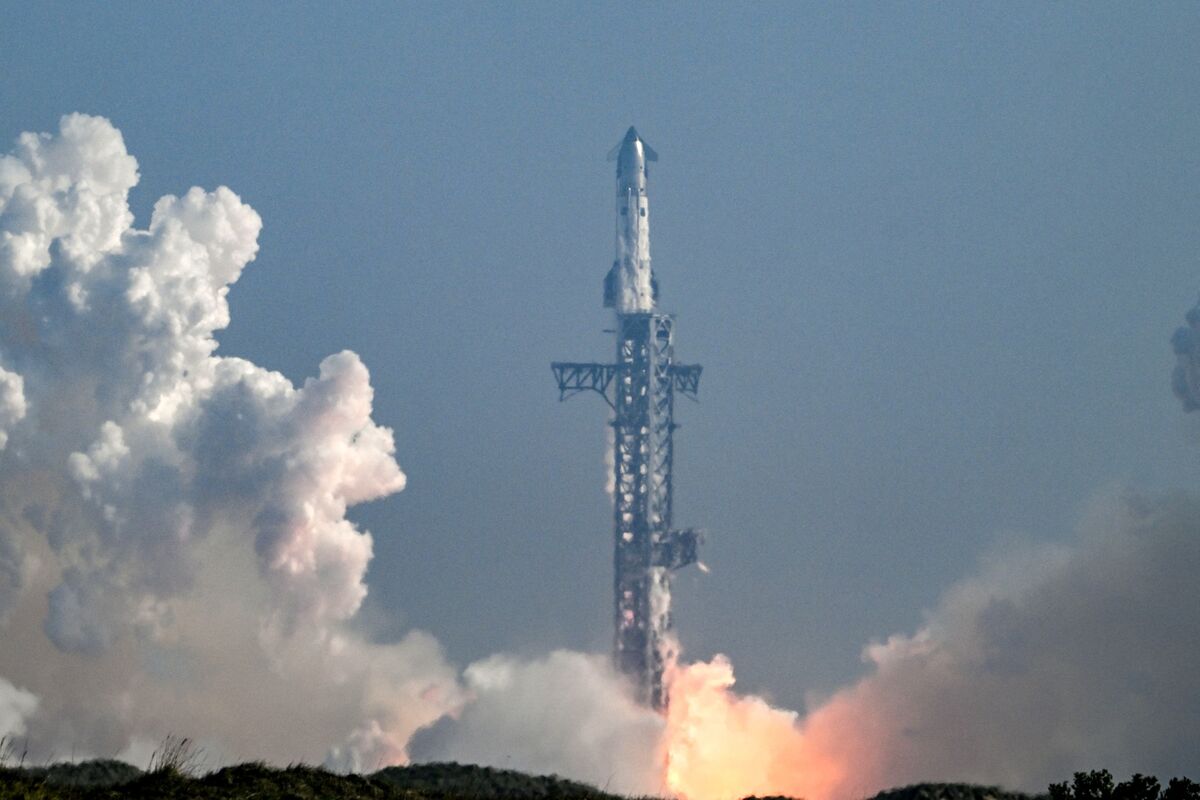
Andreessen Horowitz GP David George said SpaceX's Starship could make orbital data centers feasible, calling Starship's "rapid reusability" crucial for expanding AI computing capacity into space. He argued terrestrial AI data center capacity is becoming constrained, and framed future orbital systems as "airplane-sized GPU racks in space." The piece is commentary rather than a company-specific financial update, so near-term market impact looks limited.
The market is likely underpricing the fact that orbital compute is not a software story first; it is a launch-cost, power-density, and thermal-management story. If reusable heavy lift truly cuts marginal access-to-orbit enough, the bottleneck shifts from “can you launch a payload?” to “can you package GPUs, radiators, and power systems into an economically survivable unit,” which favors vertically integrated space infrastructure, components, and defense primes with space thermal/propulsion exposure. The first-order winners are not the AI platforms themselves but the picks-and-shovels stack: launch, radiation-hardened semis, power electronics, advanced materials, and ground-network operators.
The second-order effect is more important: terrestrial data center expansion may not be displaced so much as repriced. Even if orbital compute remains niche for 3-5 years, the existence of a credible off-planet capacity option gives hyperscalers leverage in GPU procurement, land/power negotiations, and utility interconnect timing. That can cap the multiple on “all-in on earth-bound AI capex” names if investors start discounting future scarcity rents in electricity and cooling, especially in markets already stretched on grid capacity and permitting.
The real constraint is not enthusiasm; it is reliability and maintenance economics. A single reusability or launch cadence hiccup pushes this theme back by years because orbital compute only matters if uptime, replacement, and scaling costs fall into a narrow band. In the meantime, the stronger trade is to own the enabling stack where demand is less speculative and more immediate, while fading pure-play orbital-compute hype until there is evidence of repeat launch cadence, in-space servicing, and commercial payload commitments.
AI-powered research, real-time alerts, and portfolio analytics for institutional investors.
Overall Sentiment
mildly positive
Sentiment Score
0.25
