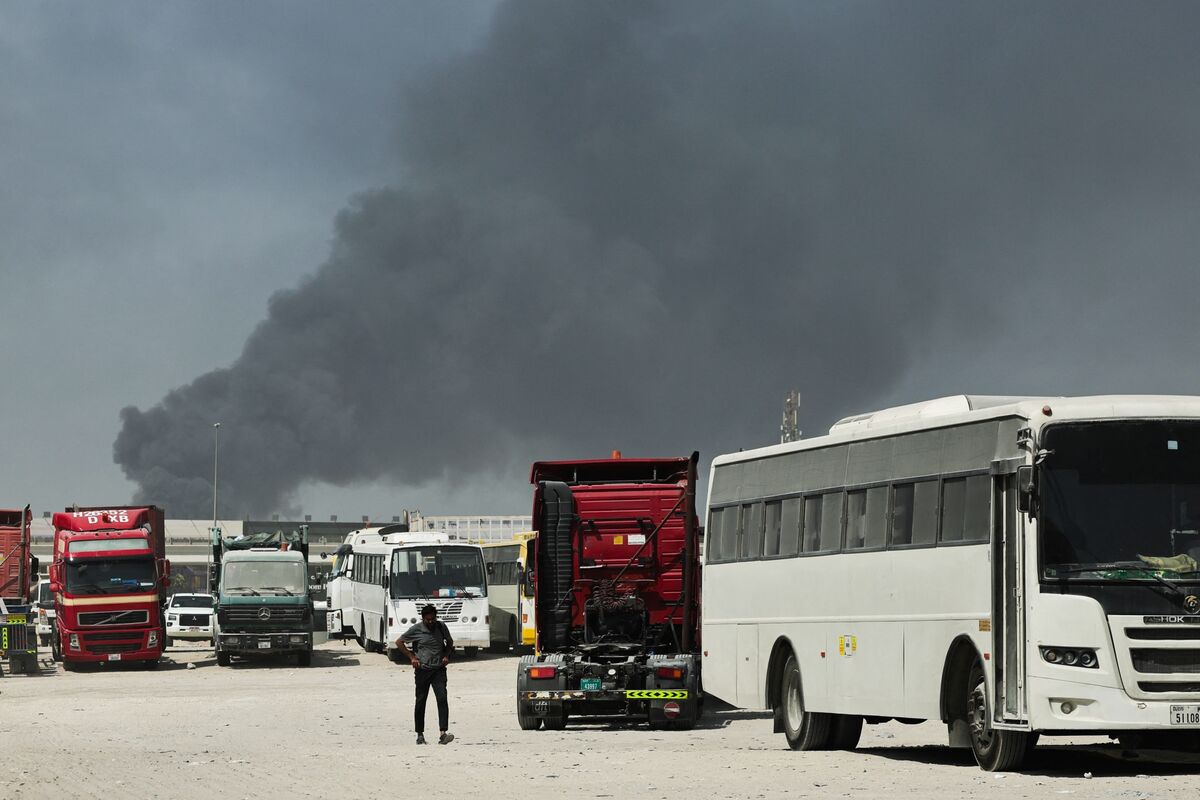
The closure of the Strait of Hormuz is forcing companies to reroute supply chains, including Siemens Energy’s contingency plan to truck massive gas turbines nearly 2,000 kilometers from Jeddah to Dammam. The article highlights a major operational disruption across Middle East trade flows as firms rewire logistics to keep economies and facilities running. The conflict-driven shutdown is a market-wide geopolitical shock with meaningful implications for shipping, energy logistics, and regional commerce.
A Hormuz shutdown is not just an energy shock; it is a forced re-rating of logistics optionality across the Gulf. The first-order winners are inland transport, warehousing, and redundant infrastructure operators that can monetize route-switching, while the bigger second-order effect is a permanent increase in capex for “war-resilient” supply chains — more onshore storage, dual-port access, and desert trucking capacity. That means margins compress for asset-light importers and project contractors, but improve for firms with scarce routing capacity, secured land corridors, and heavy-equipment handling expertise.
The most important market implication is that the disruption window matters more than the headline. If the closure is measured in days, the trade is mainly in freight, insurance, and diesel spreads; if it stretches into weeks, inventory rebuilds and delayed project execution begin to hit industrial earnings and capital goods order timing. In that regime, companies with regional manufacturing exposure but no local redundancy become the hidden losers even if they are not directly exposed to Gulf shipping.
Energy is less linear here than typical geopolitics trades. A sustained closure should lift delivered LNG and refined-product prices faster than crude benchmarks because physical barrels still need alternative paths, and inland bottlenecks create a premium on fungible molecules and storage. The contrarian risk is that markets may be underpricing the speed at which rerouting capacity gets added once the shock is visible; that favors a mean-reversion trade after the first spike, especially if diplomatic de-escalation restores passage before full inventory depletion.
From a positioning standpoint, the best risk/reward is to own the bottlenecks and fade the broad beta. The near-term relative value is strongest in logistics, tanker-adjacent services, storage, and defense infrastructure beneficiaries versus industrials with Gulf dependence. For energy, the cleaner expression is products and LNG logistics over crude itself, because the real scarcity premium comes from transport constraints, not just molecule availability.
AI-powered research, real-time alerts, and portfolio analytics for institutional investors.
Request DemoOverall Sentiment
moderately negative
Sentiment Score
-0.35
