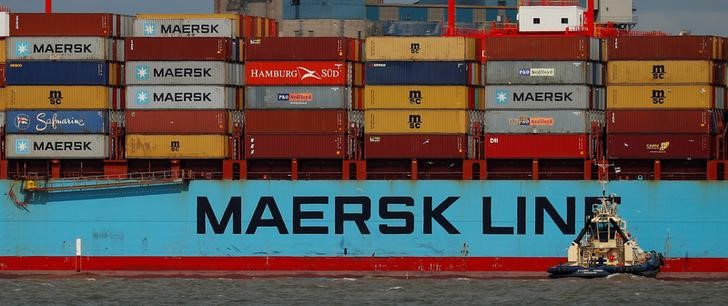
Goldman Sachs upgraded A.P. Moeller-Maersk to “neutral” from “sell,” lifting its 12-month price target to 16,000 DKK from 13,000 DKK. The move reflects a less severe container supply-demand deterioration, with 2026 EBITDA raised to $9.98B from $7.68B and 2027 EBITDA to $8.31B from $7.26B (vs ~$6B consensus), implying less risk of a price war. Goldman also expects North-South freight rates to rebound (Q3 EBITDA $3.90B, ~40% above consensus) while flagging key downside risks from a full Red Sea reopening (~10% capacity release) and weaker global trade growth.
The main implication is not that shipping is “fine,” but that the oversupply cycle may be slipping rightward faster than the market modeled. If vessel deliveries keep missing schedules, the earnings floor for the strongest carrier rises disproportionately because pricing power is determined by marginal capacity, not average fleet growth; that supports a better path for Maersk’s cash generation over the next 2-6 quarters even if spot rates normalize after the seasonal peak.
The second-order beneficiary is anyone competing for the same engine and generator capacity. Datacenter-driven diesel demand can tighten a bottleneck that was already constraining marine delivery schedules, which mechanically protects freight rates by delaying incremental supply; that is bullish for incumbent carriers and bearish for asset-heavy rivals trying to add capacity. The loser set is broader global merchandisers and importers: if rates stay elevated into year-end, freight inflation will hit margin-sensitive retail and consumer-discretionary names before it shows up in top-line data.
The real tail risk remains a sudden release of effective capacity if Red Sea lanes normalize. That would hit rate assumptions much faster than demand slowdowns, because it is a supply shock in reverse and could overwhelm the delivery-slippage thesis within weeks. So the trade is tactical, not structural: the near-term setup is constructive into Q3, but the longer-dated risk/reward deteriorates if spot rates fade before the market has repriced capex discipline.
Contrarian read: consensus is still treating this as a late-cycle bull trap, while the bigger risk may be underestimating how long supply constraints can persist when engine lead times and vessel delivery schedules both slip. The market may be over-allocating attention to 2027 overcapacity and underweighting the fact that the P&L inflection is front-loaded in the next 1-3 quarters.
AI-powered research, real-time alerts, and portfolio analytics for institutional investors.
Request DemoOverall Sentiment
strongly positive
Sentiment Score
0.55
Ticker Sentiment
