
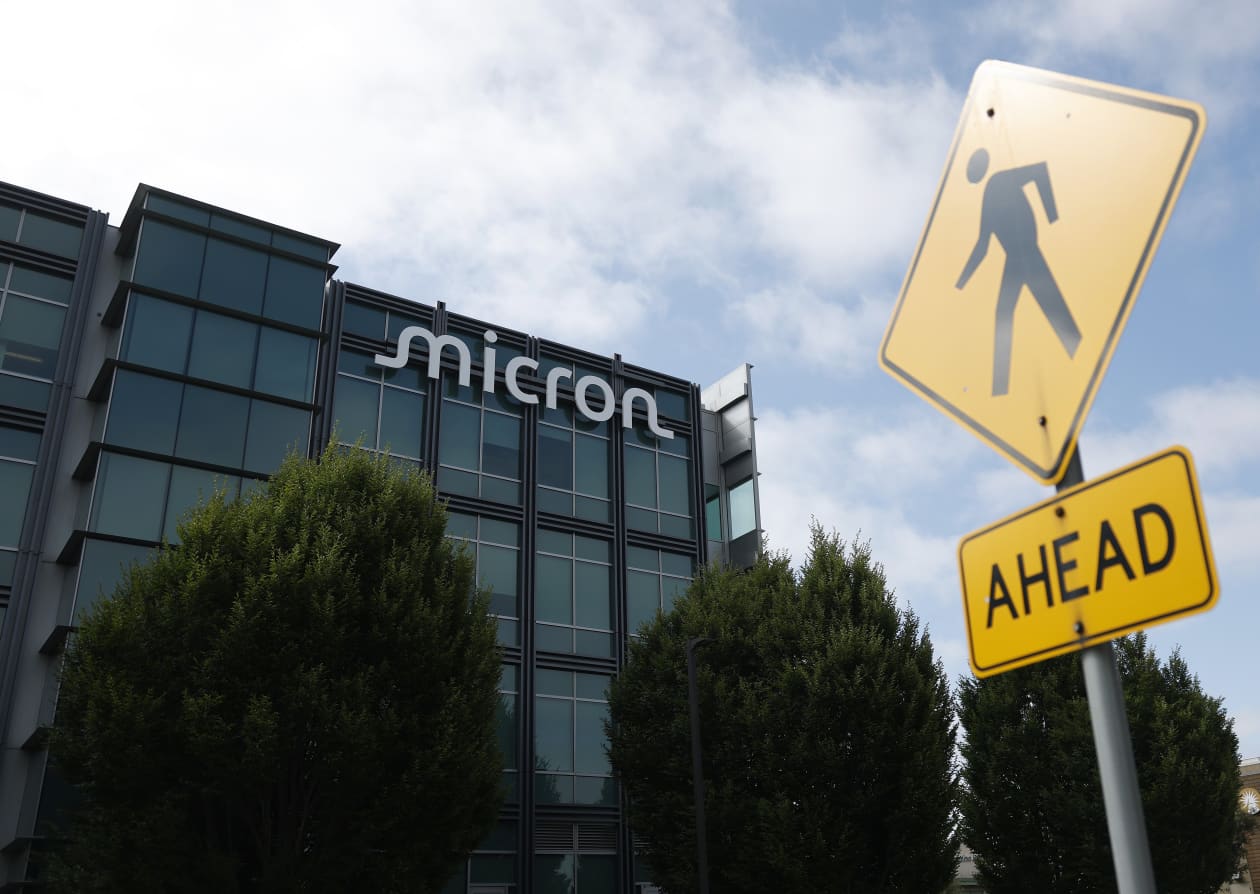
Micron (MU) is being framed as “the most important stock in the market,” acting as a proxy for the AI cycle and investor risk-taking. While investors worry about a potential memory-chip earnings peak, analysts argue the shares still look cheap across multiple earnings scenarios. Net: positive skew on valuation, but with acknowledged cyclical/peak risk.
MU is less a stand-alone semiconductor story than a liquidity barometer for the AI trade. When a memory name starts trading like a macro proxy, that usually means the market is willing to pay for earnings power only as long as the AI capex cycle stays intact; if that assumption wobbles, the de-rating can be fast because memory is one of the few places where ASPs and sentiment both move together. The setup is therefore asymmetric: upside persists if HBM demand keeps outpacing supply, but downside is amplified if investors conclude the current cycle is closer to a peak than a plateau.
Second-order winners are the AI infrastructure names that benefit from continued data-center spending and still have leverage to a prolonged memory shortage; losers are the broader semiconductor and hardware baskets if MU becomes the first place the market looks for evidence of peak spend. In practice, MU weakness would likely bleed into SOXX/SMH, and then into high-multiple AI beneficiaries as investors question whether demand is broadening or just pulling forward purchases. That matters because the read-through is not just fundamentals but factor exposure: crowded AI longs could unwind on a modest disappointment if MU signals inventory normalization or pricing deceleration.
The near-term catalyst path is earnings/guidance and any commentary on inventory, mix, and HBM qualification cadence over the next 1-3 months. The structural horizon is 6-18 months: if memory pricing stabilizes at a higher floor, MU can stay inexpensive on forward scenarios, but if pricing rolls over, the market will compress the multiple before the income statement fully shows it. What would falsify the bullish case is a guide that implies gross margin expansion stalls, inventory days rise, or HBM tightness eases faster than expected.
AI-powered research, real-time alerts, and portfolio analytics for institutional investors.
Overall Sentiment
mildly positive
Sentiment Score
0.15
Ticker Sentiment
