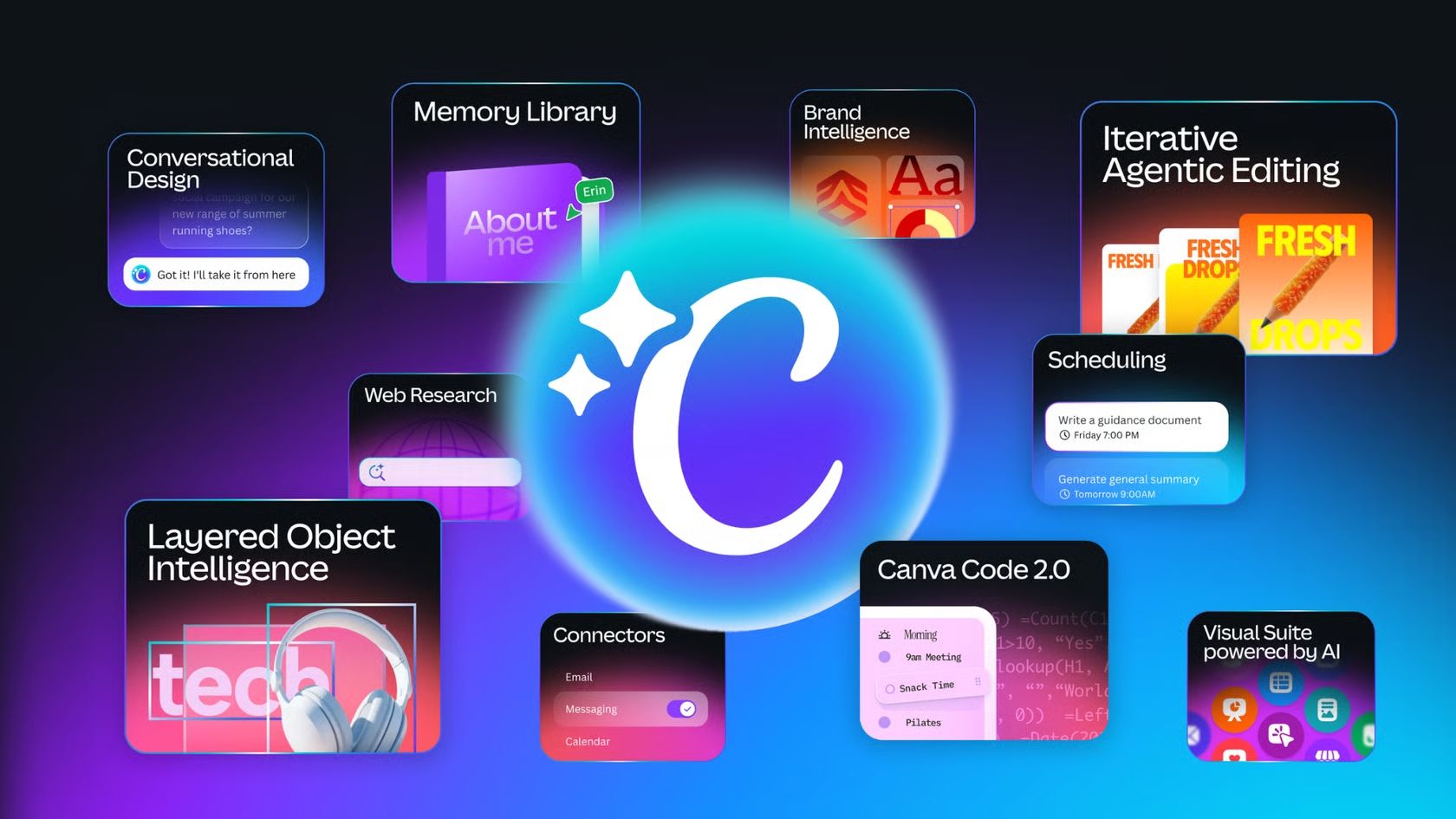
Canva launched Canva AI 2.0, a conversational design orchestration layer that can generate layered, editable brand campaigns from a text prompt and coordinate changes across multiple assets. The update also adds Memory Library, web research, Canva Code 2.0, and new connectors for Slack, Google Drive, and Zoom, broadening the platform's workflow automation capabilities. The product is currently in research preview, making this an encouraging but early-stage release with limited near-term market impact.
This is less about a single feature release and more about Canva moving up the software stack from tool vendor to workflow controller. If the AI layer becomes the default starting point for campaigns, Adobe’s moat shifts from creative depth to distribution and enterprise workflow integration; that is a slower, but more dangerous, share threat because it attacks seat expansion and engagement frequency rather than just feature parity. The most vulnerable usage is high-volume, template-driven marketing work where speed, consistency, and cross-format output matter more than advanced pro controls.
The second-order effect is that “editable AI output” reduces switching costs inside Canva’s own ecosystem while raising them for competing point solutions. If teams can generate a campaign, then iterate individual assets, then reuse memory/style context, Canva can become the system of record for brand assets; that compresses the value of standalone design plugins, DAM-light tools, and some low-end agency workflows over the next 6-18 months. The AI assistant also creates a land-grab dynamic for collaboration and connectors, which could make Canva stickier in SMB/mid-market before Adobe’s enterprise sales motion fully responds.
For Adobe, the near-term risk is not an immediate revenue hit but a multiple overhang if investors start pricing lower net retention in creative cloud and slower attach of AI monetization. The bear case is most acute over 2-4 quarters if Canva shows measurable uplift in paid conversion, higher usage per user, or lower churn from AI-enabled workflows. The counterpoint is that enterprise buyers may still prefer Adobe where governance, compliance, and deep pro-grade editing matter; if so, the market is likely to over-discount a long-duration competitive threat before seeing real budget reallocation.
The contrarian setup is that the market may be underestimating how much of this is an SMB productivity feature, not a direct enterprise replacement. That means the first-order share reaction in ADBE could be too harsh unless there is evidence of demand leakage in creative teams and marketing departments. The cleaner trade is to fade any knee-jerk downside in Adobe only after checking for weakening usage trends, while using any strength in Canva-adjacent sentiment to express the long-duration AI workflow winner thesis.
AI-powered research, real-time alerts, and portfolio analytics for institutional investors.
Request DemoOverall Sentiment
mildly positive
Sentiment Score
0.35
Ticker Sentiment
