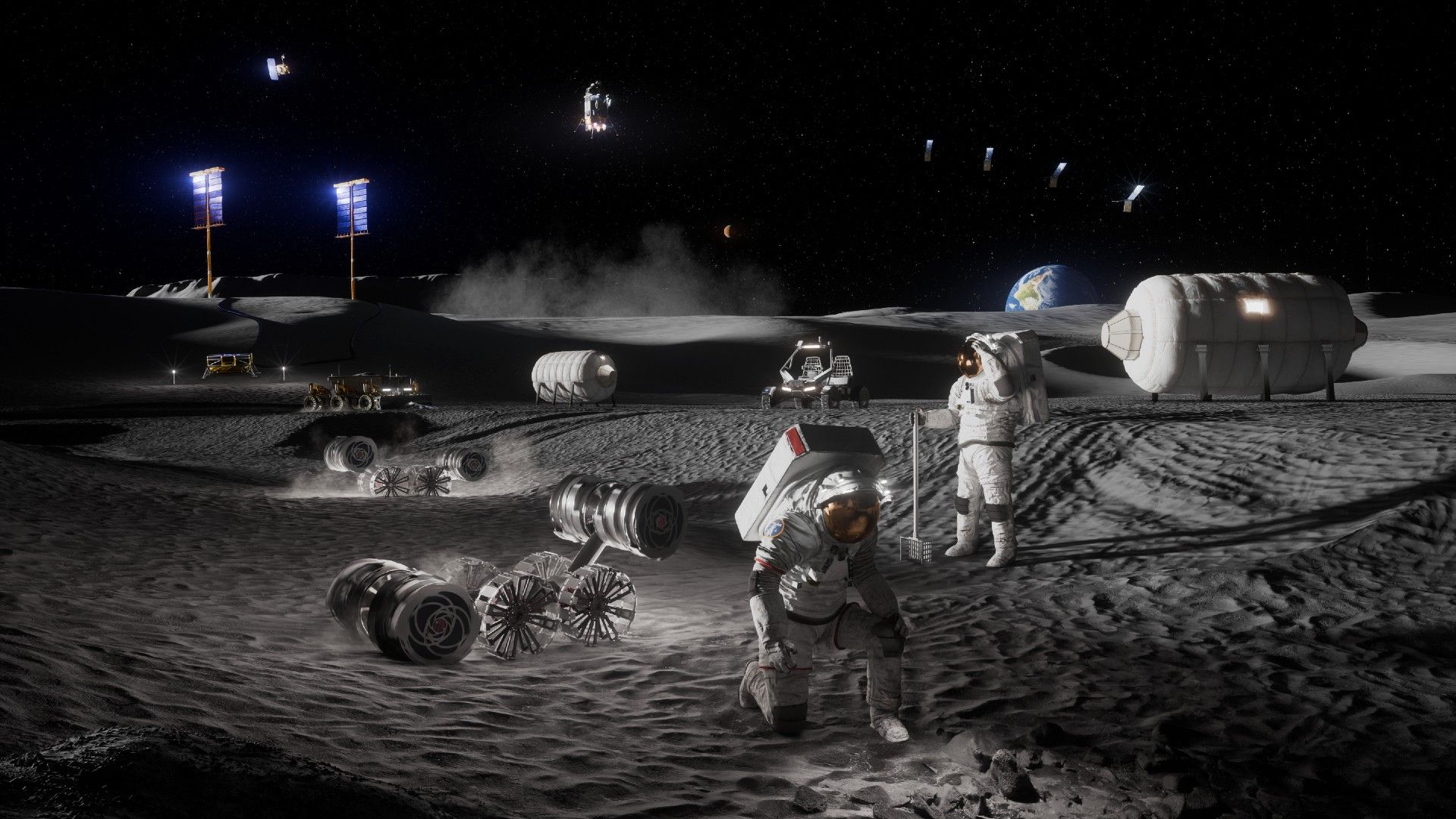
NASA unveiled a $20 billion Moon Base plan and outlined three uncrewed lunar missions, with Moon Base I targeted for as early as fall 2026 and two additional missions planned for later this year. Blue Origin won the first mission contract using its Blue Moon Mark 1 Endurance lander, part of NASA's Phase I push toward a permanent lunar presence and eventual Mars exploration. The announcement is strategically positive for the space sector, though the timeline remains aggressive and execution risk is high.
This is a multi-year budget-and-procurement signal, not a near-term revenue inflection, but it meaningfully improves the probability distribution for the lunar industrial complex. The key second-order effect is that NASA is effectively turning the moon into an infrastructure market: landers, mobility systems, comms, autonomy, power, thermal, and surface operations all become recurring categories rather than one-off mission sales. That favors the few names with flight heritage and integration capability, while weaker point-solution vendors face a higher bar because mission failures now have reputational, political, and budget consequences. The near-term winner is the prime with the first payload assignment, but the broader opportunity set is in subcontractors that can monetize repeat cadence as Phase I transitions into semi-permanent infrastructure. The biggest constraint is not engineering ambition but schedule credibility: if the first wave slips, capital tends to rotate away from pure-play lunar names toward diversified defense/space platforms with adjacent exposure. That argues for owning the ecosystem, not just the headline winner, because procurement over the next 12-24 months should reward suppliers of enabling tech more than companies dependent on a flawless lunar landing narrative. The contrarian read is that the market may be underpricing how political this is. If the timeline becomes a geopolitical race metric versus China, NASA funding can become less cyclical and more strategically protected, which supports a longer-duration multiple expansion for the space supply chain. But if there is a visible failure in the initial uncrewed missions, the sector can de-rate quickly as investors reprice execution risk and question whether this is another Artemis-style delay cycle rather than a genuine industrial buildout.
AI-powered research, real-time alerts, and portfolio analytics for institutional investors.
Overall Sentiment
mildly positive
Sentiment Score
0.25
Ticker Sentiment
