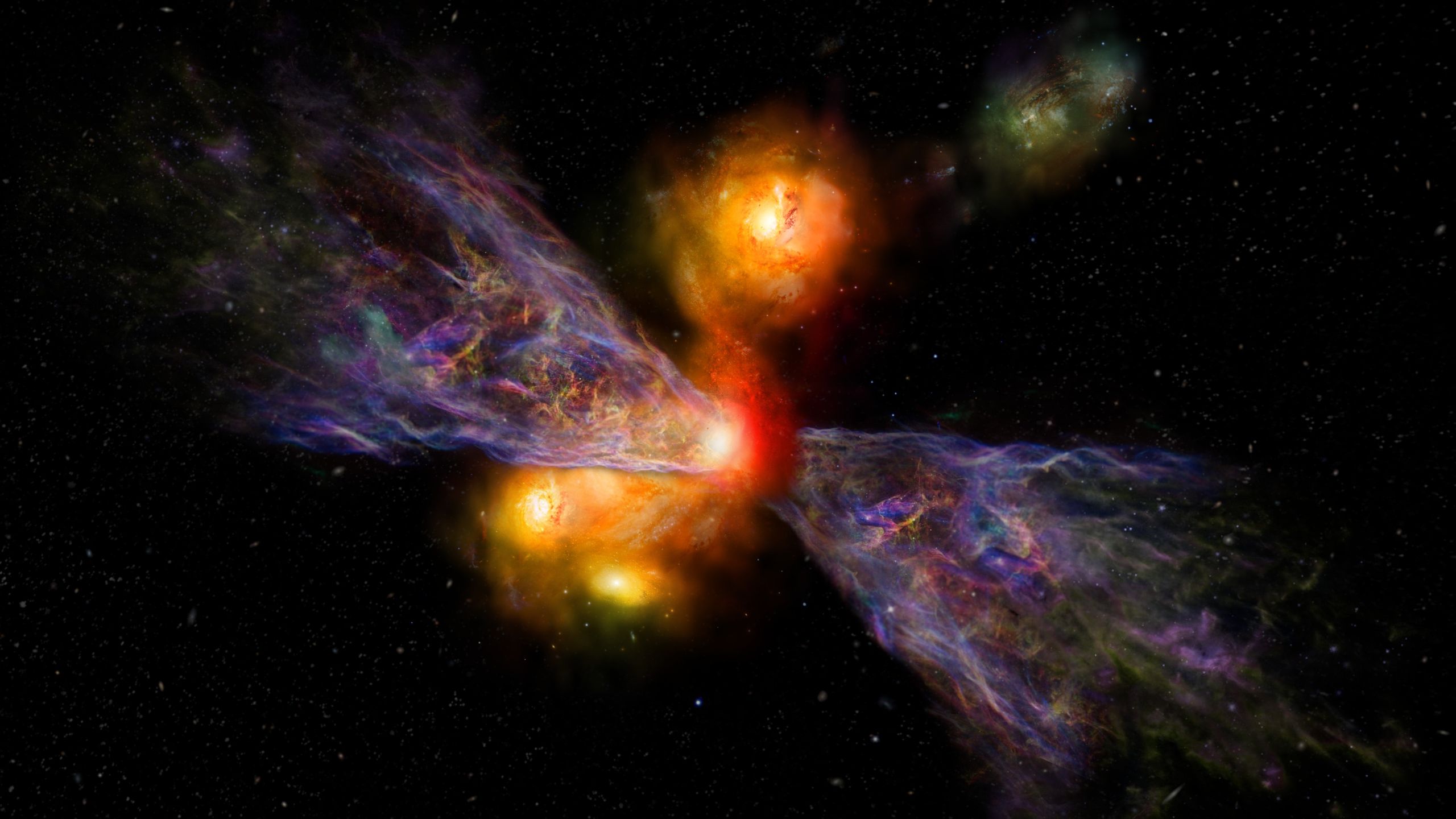
JWST observations of the CRISTAL-02 galaxy system, about 1 billion years after the Big Bang, show a powerful outflow ejecting more than 500 solar masses of gas per year and potentially quenching star formation. The study suggests collision-driven stellar winds may explain why some early massive galaxies became quiescent quickly, while also noting black-hole-driven outflows cannot be ruled out. The findings are scientifically important but have limited direct market relevance.
This is less a space-physics story than a validation of a broader modeling regime: violent feedback can terminate growth quickly once systems cross a density threshold. The second-order implication is not the headline itself, but that merger-driven blowouts appear to be an efficient “switch” for shutting off resource conversion; in markets, that favors the thesis that early overaccumulation can reverse abruptly once a bottleneck is hit. In adjacent industries, the relevant beneficiaries are the toolmakers and compute-heavy firms whose models ingest JWST/ALMA-like data, because every new direct observation reduces uncertainty around galaxy-formation simulations and improves the addressable market for astroinformatics, high-performance storage, and sensor fusion.
The most interesting contrarian angle is that the apparent consistency of outflow efficiency over cosmic time may be more valuable than the specific object studied. If feedback physics is stable, then the market opportunity is in simulation calibration, not discovery headlines; the winner is software and instrumentation, not one-off telescope science. That supports a longer-duration bid for platform providers with recurring government/academic demand, while pure-exposure hardware names remain more cyclical and vulnerable to budget timing.
Risk is that this remains an attribution problem: stellar feedback and black-hole feedback are observationally difficult to disentangle, so the mechanism may be less settled than the article implies. If the consensus over-weights the ‘starburst wind’ interpretation, the near-term trade is probably in the wrong layer of the stack. Any pricing impact should show up over months, not days, as grant allocation, NASA/ESA procurement, and university compute budgets respond to improved confidence in early-universe modeling.
AI-powered research, real-time alerts, and portfolio analytics for institutional investors.
Request DemoOverall Sentiment
neutral
Sentiment Score
0.15
