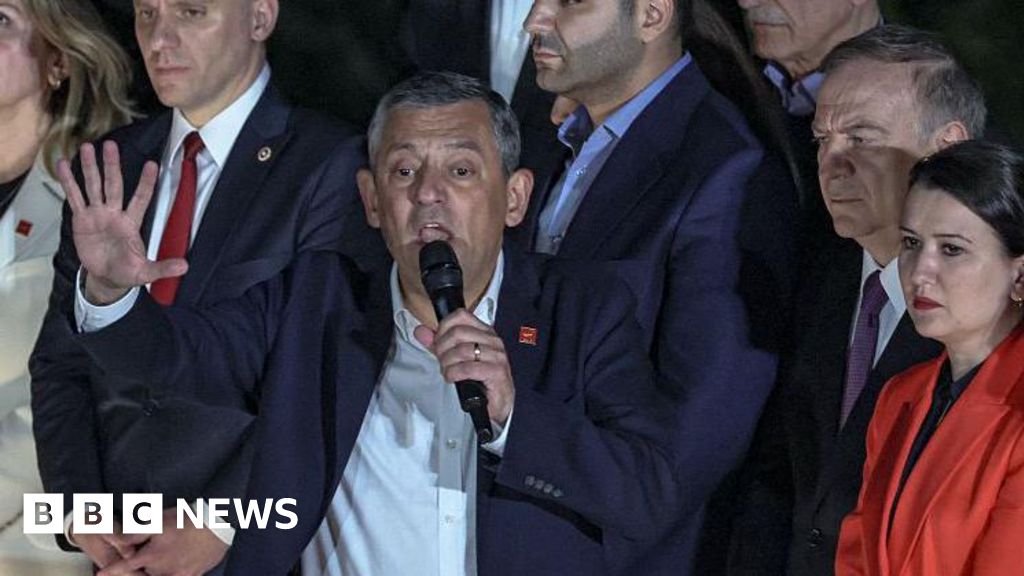
Turkey's appeals court voided the CHP's 2023 leadership election, ordering Özgür Özel replaced by Kemal Kilicdaroğlu and effectively resetting the party's executive leadership. The decision triggered thousands of protests, pushed Turkey's stock market down 6% intraday, and deepened concerns about judicial pressure on the opposition under Erdogan. The article also notes possible snap-election positioning and the overnight closure of Bilgi University, reinforcing the perception of rising political and institutional risk.
This is less a one-off legal headline than a structural regime-risk event: the market is being forced to reprice Turkey from an idiosyncratic EM story to a system where political control increasingly substitutes for institutional constraints. The immediate loser is domestic financial confidence, but the second-order damage is broader: bank funding costs, corporate capex decisions, and foreign direct investment all become hostage to a higher probability of arbitrary legal outcomes. That typically shows up first in the curve and the currency, then in equities with a lag as locals de-risk and foreign holders fight liquidity.
The key market mechanism is not simply “sell Turkey,” but “short duration + short domestic beta + long hard-currency earners.” When the opposition’s organizational infrastructure is weakened, the probability of an early-election trigger or further escalation rises, which can create episodic market air pockets over days to weeks. Any rebound in equities is likely to be tactical unless there is an explicit legal stay or a credible intra-party compromise; absent that, the path of least resistance is continued multiple compression for banks, construction, real estate, and other leverage-to-domestic-demand sectors.
The contrarian angle is that the market may already be close to maximum pessimism on politics while underpricing how long this can be managed without a broader financial accident. Erdogan’s control can suppress headline volatility for periods, but it often does so by forcing policy into a tighter corner—especially if FX pressure re-accelerates and the central bank is asked to defend stability with limited credibility. That sets up a nonlinear risk: political consolidation can be equity-negative today but eventually bullish for volatility, FX hedges, and any asset with offshore or export-linked cash flows.
AI-powered research, real-time alerts, and portfolio analytics for institutional investors.
Request DemoOverall Sentiment
strongly negative
Sentiment Score
-0.65
