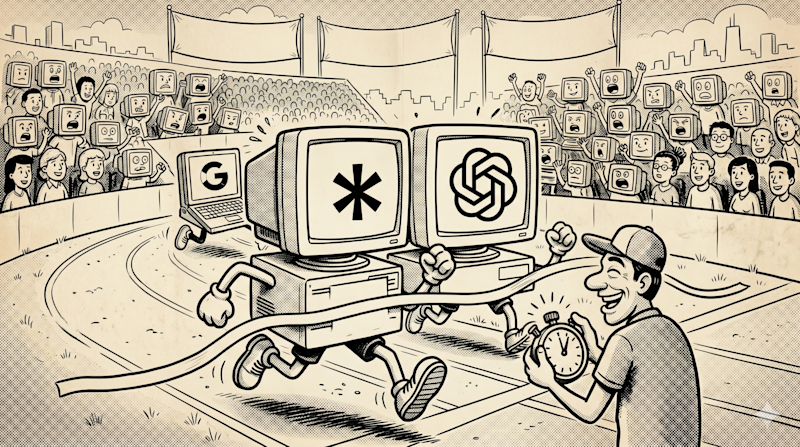
Anthropic launched Claude Opus 4.7 with leadership benchmarks in knowledge work (GDPVal-AA Elo 1753), agentic coding (64.3% on SWE-bench Pro), and visual reasoning, while keeping API pricing unchanged at $5/$25 per million tokens. The release also adds an xhigh effort tier, task budgets, and stronger cybersecurity safeguards, positioning the model as a more reliable enterprise agent despite higher token usage and stricter prompting requirements. The article also highlights Anthropic’s rapid growth to a $30B annual run-rate and rising valuation interest, offset by legal pressure from the U.S. Department of War and user complaints about prior model degradation.
The key equity implication is not just that Anthropic is shipping a better model, but that it is converting frontier AI from a headline feature into a controlled enterprise utility. That favors the cloud distributors and workflow software layer more than the model vendor itself: when customers standardize on governed, metered, multi-cloud inference, the incremental value leaks into platform consumption, observability, and application-specific tooling. GOOGL benefits disproportionately if this drives more Vertex AI adoption and higher stickiness in enterprise AI workloads, while the model pricing hold implies competition is shifting from raw token margins to enterprise control planes.
For INTU, the bigger signal is that the market may be underestimating how quickly high-trust AI can penetrate financial workflow automation. The most important second-order effect is not consumer-facing tax prep, but internal use cases around reconciliation, anomaly detection, and support triage where self-verification matters more than creativity. If enterprise buyers accept higher unit economics in exchange for lower supervision costs, software vendors with proprietary data and compliance-heavy workflows can expand attach rates and reduce churn, even if the underlying model layer becomes more commoditized.
The main risk to the bullish read is that this release could accelerate buyer bifurcation rather than broad adoption. Strict instruction-following, higher token burn, and prompt re-engineering create a near-term implementation tax, so many enterprises may test aggressively but defer full rollout for 1-2 quarters. If usage growth slows after the initial trial wave, the revenue uplift for cloud partners could be back-end loaded, and any disappointment would hit the AI infra complex first.
The contrarian view is that consensus may be overpricing model-quality headlines and underpricing workflow friction. A model that is better at reasoning but more literal can actually reduce throughput in existing deployments until prompts, guardrails, and budgets are re-architected. That makes this less of a pure “more AI demand” story and more of a timing trade: near-term adoption should favor vendors that sit closest to enterprise workflow pain points, while broad model exuberance may be vulnerable if the market realizes production rollout is slower than benchmark gains imply.
AI-powered research, real-time alerts, and portfolio analytics for institutional investors.
Request DemoOverall Sentiment
moderately positive
Sentiment Score
0.35
Ticker Sentiment
