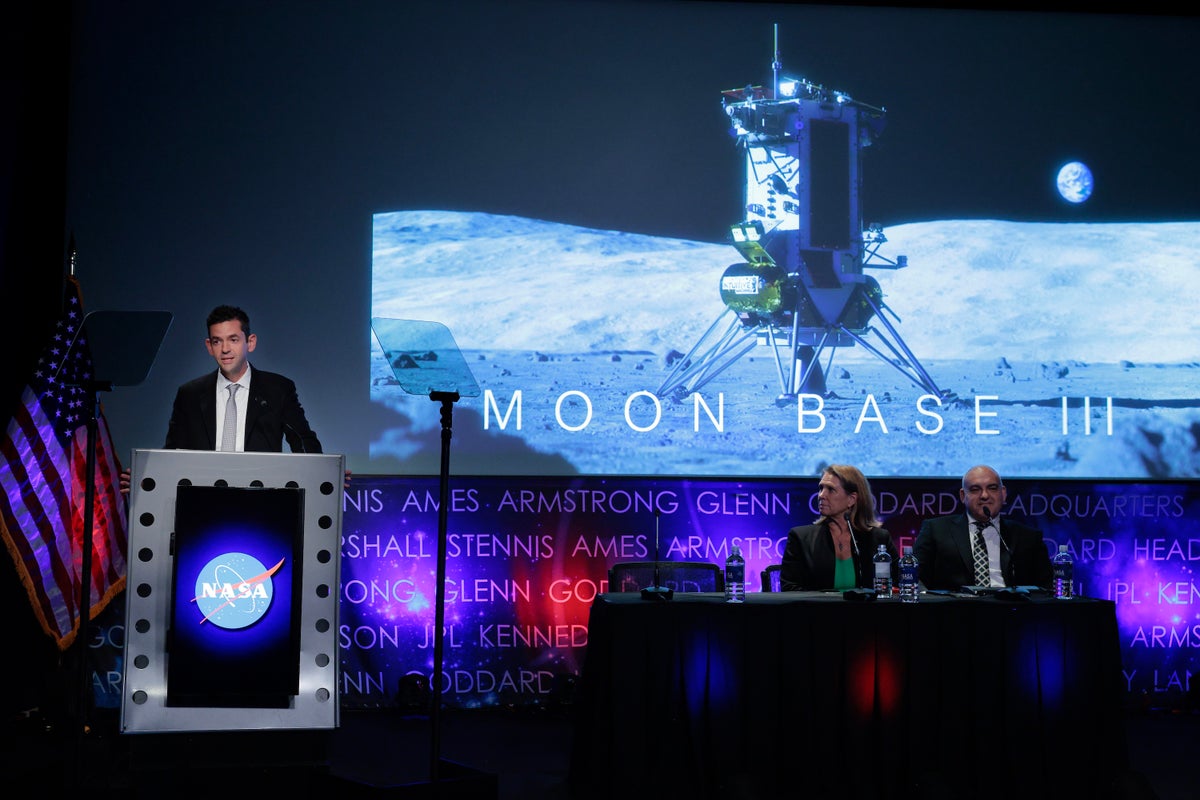
NASA outlined a multi-year lunar buildout centered on a permanent moon outpost in the 2030s, including more than $200 million apiece in contracts to Astrolab and Lunar Outpost for astronaut lunar terrain vehicles. Blue Origin won key roles across cargo and crewed lunar systems, with its Mark 1 lander slated to fly two science missions and its Mark 2 lander positioned as an Artemis IV crew vehicle option. The plan adds clear commercial opportunities for U.S. space companies, though execution risk remains high given that neither SpaceX nor Blue Origin has yet soft-landed on the moon.
The key market implication is not the headline optimism around lunar exploration; it is the conversion of NASA from a single-prime program into a multi-vendor procurement engine. That structure improves revenue visibility for the better-capitalized integrators, but it also shifts risk from technical success to execution sequencing: the first company to demonstrate repeatable delivery wins disproportionate follow-on work, while any slip will likely re-route capital to the next provider rather than shrink the category. For LUNR, the near-term setup is more about option value than near-dated earnings. The stock should respond to each mission milestone over the next 3-9 months because the market will be repricing probability of becoming a recurring lunar logistics platform, not just a one-off lander vendor. The second-order winners are likely component suppliers in propulsion, guidance, power, thermal, and autonomous navigation; those businesses can capture content across multiple landers without needing to own the full mission risk. The contrarian read is that the market may be overestimating how linear this roadmap is. Aerospace programs with public visibility tend to amplify binary headlines, but the real bottleneck is cadence: successful back-to-back landings, not awards. If the first few flights are only partially successful or slip by a quarter or two, the time value embedded in the current enthusiasm decays quickly, even if the ultimate 2030s moon-base thesis remains intact. The cleanest risk/reward is to own the names with asymmetric rerating potential into the first demos while hedging against schedule slippage. In the background, this also increases strategic pressure on SpaceX to prove Starship reliability faster; if Starship continues to lag, NASA’s procurement mix could tilt toward Blue Origin and diversified contractors, which is positive for the broader lunar supply chain but negative for any single-vendor monopoly narrative.
AI-powered research, real-time alerts, and portfolio analytics for institutional investors.
Request DemoOverall Sentiment
mildly positive
Sentiment Score
0.32
Ticker Sentiment
