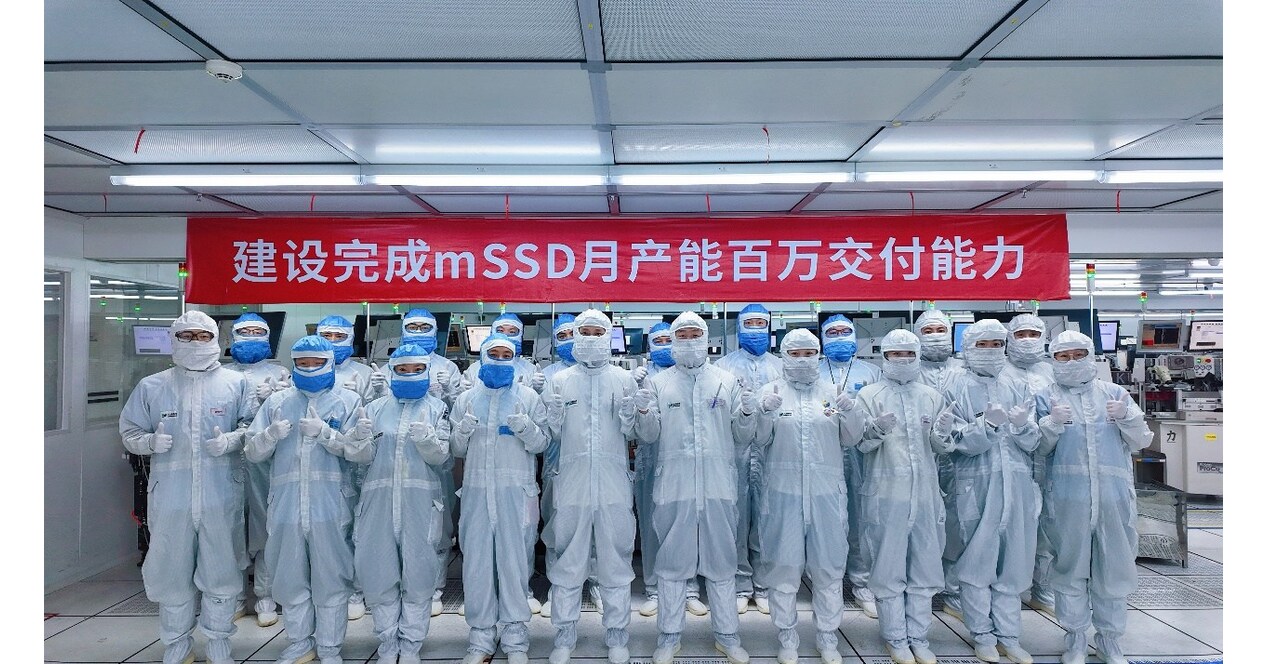
Longsys said it has reached stable mSSD production capacity of 1 million units per month after ramping to that level in June 2026 (with first samples rolling off in Oct 2025). The expanded output is targeted at accelerating edge AI storage adoption, supported by PCIe Gen4/Gen5 mSSD offerings using SiP integration and VC cooling in the Gen5 version. The company is also pushing its SPU™/iSA™/HLCache™ intelligent storage platform, working with customers including Lenovo and ASUS.
This reads less like a near-term earnings inflection and more like a proof-of-capability event: the market should care only if the one-million-unit run rate converts from promotional capacity into repeat purchase orders with decent mix and pricing discipline. The strategic upside is that Longsys is trying to move up the value chain from commodity memory assembly into a more integrated, design-in-heavy platform, which can expand wallet share in AI PCs and edge devices if it becomes sticky at the OEM level. The first-order winner is Longsys; the second-order winner is OEMs like Lenovo and ASUS if they can differentiate on power/thermal efficiency without taking much BOM cost inflation.
The competitive risk is that this may compress industry pricing rather than create a new moat. If SiP mSSD gains traction, traditional SSD/module assemblers with weaker packaging integration and less thermal engineering are most exposed, while the incremental NAND demand likely accrues to upstream suppliers with little margin capture. The key question over the next 1-3 quarters is whether this is a real design-win pipeline or just capacity ahead of an uncertain adoption curve; if adoption is slow, utilization can become a margin drag instead of a growth lever.
Contrarianly, the consensus may be underestimating how quickly edge-AI form factors can reward mechanical integration over raw controller specs, especially in compact AI boxes and premium notebooks. But the move is also vulnerable to substitution: if Gen5 power/thermal overhead proves annoying in real-world deployments, OEMs could revert to standard M.2 solutions or delay upgrades until Gen6 economics are clearer. For the thesis to hold, we need evidence of gross margin stability, multi-customer adoption beyond a handful of named accounts, and no deterioration in working capital as production scales.
AI-powered research, real-time alerts, and portfolio analytics for institutional investors.
Request DemoOverall Sentiment
mildly positive
Sentiment Score
0.25
