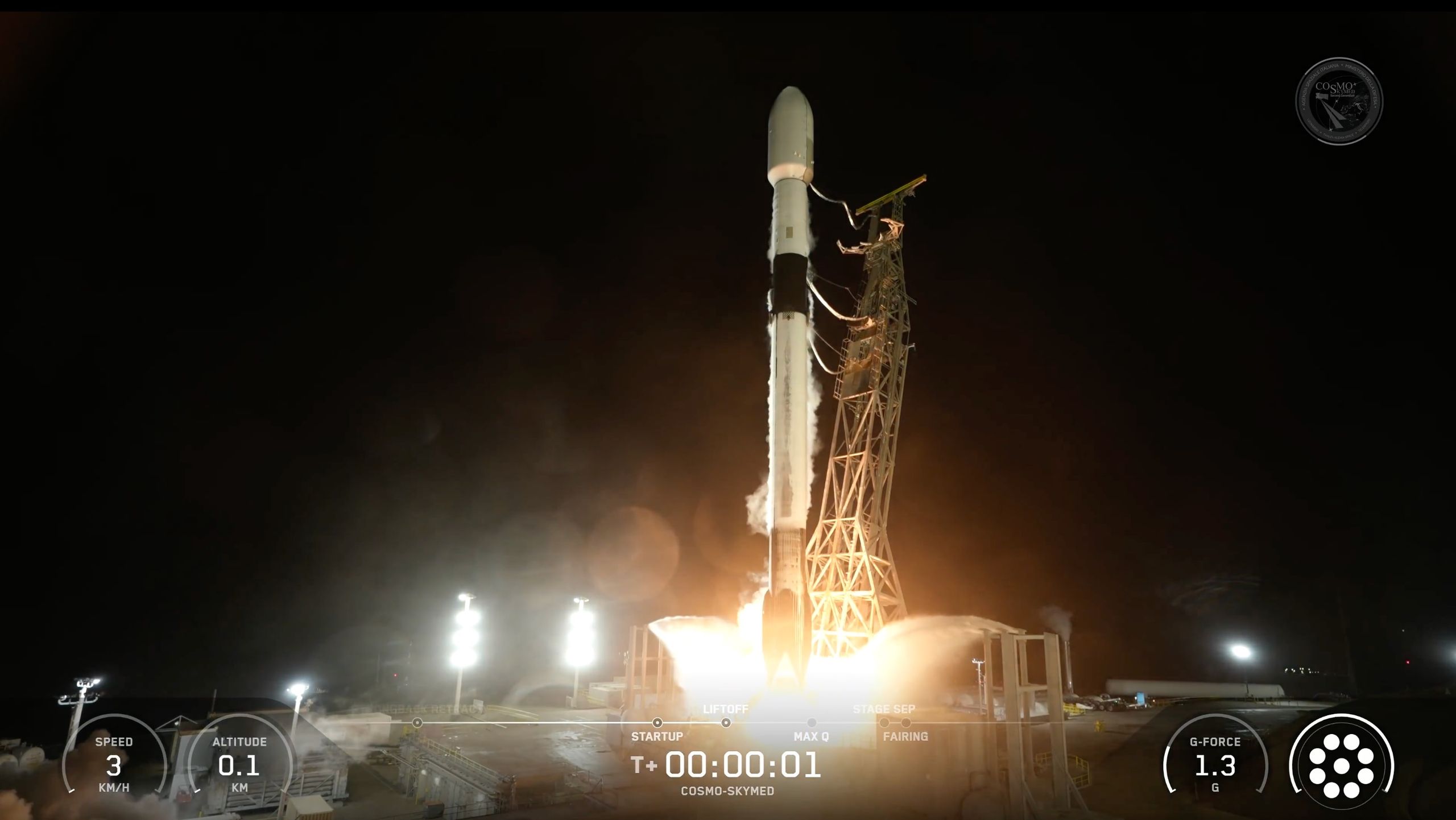
SpaceX's Falcon 9 launched a COSMO‑SkyMed Second Generation synthetic-aperture-radar Earth-observation satellite for the Italian Space Agency and the Italian Ministry of Defence from Vandenberg on Jan. 2, deploying the payload into ~385 miles (620 km) LEO and successfully landing the first stage on its 21st flight. The mission — the third in the COSMO‑SkyMed SG series and the first orbital launch globally in 2026 — reinforces SpaceX's high-cadence, reuse-driven launch economics after a record 165 orbital missions in 2025, underlining its competitive positioning in government and commercial satellite launches.
Market structure: SpaceX's high cadence (165 launches in 2025; first mission of 2026 now flown) reinforces durable price leadership in orbital launch — direct winners are government buyers, large defense primes (NOC, LMT, RTX) who can buy more capacity at lower unit cost, and satellite-data aggregators that can scale. Losers are niche/new small launch providers (RKLB, private micro-launchers) and legacy foreign launchers (Soyuz/Arianespace) facing pricing pressure; expect downward pressure on per-launch ASPs of 10–30% vs. pre-reuse-era within 12–24 months if cadence stays high.
Risk assessment: Tail risks include a major SpaceX anomaly (single catastrophic Falcon 9 failure) that could spike insurance rates and temporarily reprice launch demand, and regulatory/antitrust or export-control actions in 6–18 months that restrict constellation/service exports. Short-term (days–weeks) sentiment swings will dominate small-cap launchers; medium-term (3–12 months) margins compress for launch service providers; long-term (2–5 years) consolidation and vertical integration in imagery/analytics are likely. Hidden dependency: satellite-data monetization depends on gov budgets and enterprise willingness to pay for analytics, not just raw capacity.
Trade implications: Favor defense primes and satellite data integrators for 6–12 month holds while underweighting pure-play small launchers and capex-intensive satellite OEMs. Use options to express convexity: buy call spreads on NOC/LMT for 9–12 months and put spreads on RKLB/other small launchers for 3–6 months. Rebalance by rotating 1–3% portfolio weight from speculative launch equities into larger defense/sensor integrators; watch launch cadence and three-month revenue signals from MAXR/PL.
Contrarian angles: The market underestimates recurring SAR demand (disaster response, maritime surveillance) — MAXR and PL could see stable revenue uplifts rather than pure-price competition; conversely consensus overestimates how quickly lower launch costs translate to profitable new imagery businesses. Historical parallel: early airline deregulation — capacity growth depressed fares then consolidated; expect similar winner-take-most dynamics. Unintended consequence: rapid reuse increases space debris/insurance friction, which could temporarily re-elevate pricing power for insured, integrated providers.
AI-powered research, real-time alerts, and portfolio analytics for institutional investors.
Request DemoOverall Sentiment
mildly positive
Sentiment Score
0.35
