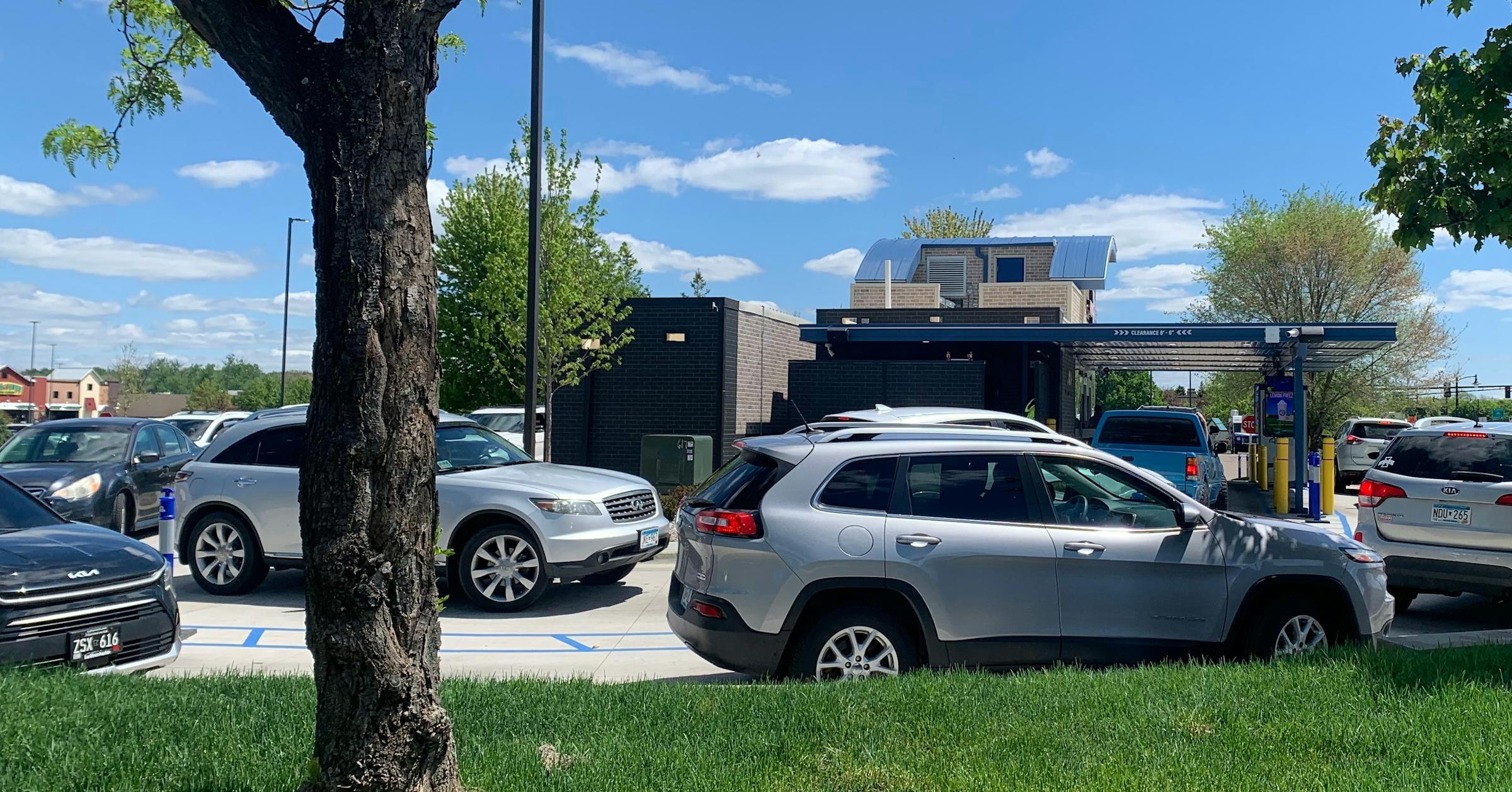
7 Brew Coffee’s first Twin Cities-area location in Vadnais Heights is drawing hour-long lines, with traffic backing up onto County Road E for more than half a mile at times. The turnout suggests strong consumer demand and significant local brand buzz around the Arkansas-based drive-through chain and its customizable beverage offerings. While the article highlights nuisance complaints about congestion, the overall takeaway is strong customer interest rather than a material financial event.
The important read-through is not that a niche drive-thru concept is busy; it’s that demand is being converted into measurable friction, which is usually the strongest early signal in consumer rollouts. Long queues imply the product is resonating enough to tolerate inconvenience, but they also cap throughput and can distort unit economics: a store can appear “viral” while underdelivering on revenue per labor hour if the line becomes self-limiting. For public comps, this supports the market’s willingness to pay up for growth narratives tied to traffic conversion rather than traditional same-store-sales math.
BROS is the cleaner beneficiary because its brand sits closest to this “fourth wave” behavior set: customizable, social-media-native, drive-up, and experience-driven. The second-order effect is that the real asset becomes not coffee demand but location scarcity and labor execution; the winners are operators that can replicate line length without creating neighborhood backlash or throughput decay. That favors scaled rollouts in suburban, car-dependent trade areas, while smaller peers risk being outspent on site buildout and digital traffic acquisition.
For SBUX, this is less a direct share-gain story than a reminder that its premium is vulnerable if younger consumers increasingly treat beverage customization as the product, not coffee itself. The risk is that “fun” beverage occasions migrate to drive-thru specialists while Starbucks remains more exposed to lower-frequency, habit-based purchases; that pressure would show up over months, not days, through weaker ticket growth and lower incremental visits. The consensus may be underestimating how much the growth category is being redefined away from coffee and toward beverage entertainment, which is a problem for incumbents optimized for café throughput and broad menu complexity.
The key downside to the bullish interpretation is that extreme lines are not always a durable positive—they can be a temporary opening-week phenomenon, and public annoyance can become a local zoning/traffic constraint that slows future openings. If franchise economics depend on sustained queue psychology, any operational fix that shortens wait times could paradoxically reduce the brand’s social proof. Over 3-6 months, the market will care less about one viral store and more about whether new units achieve repeatable payback without cannibalizing convenience.
AI-powered research, real-time alerts, and portfolio analytics for institutional investors.
Request DemoOverall Sentiment
mildly positive
Sentiment Score
0.20
Ticker Sentiment
