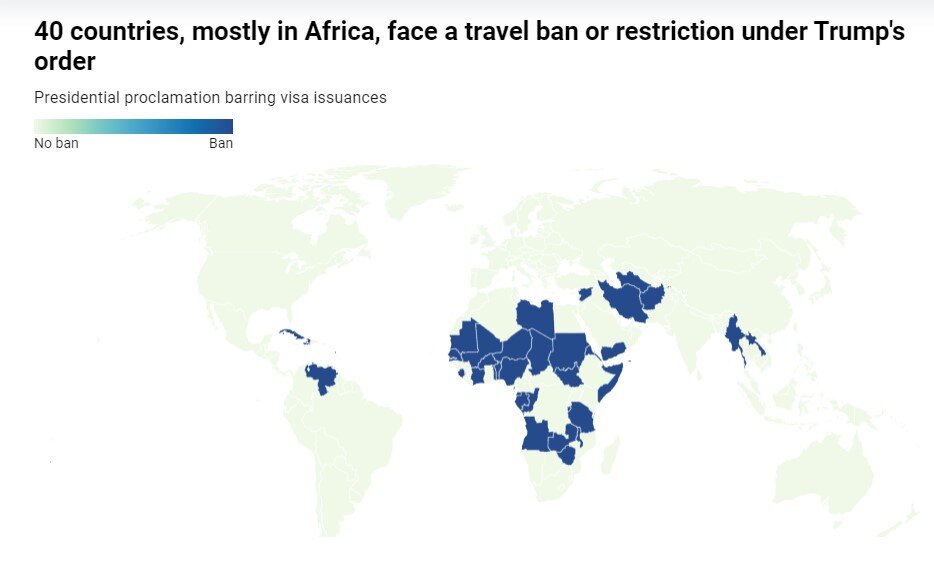
The administration issued a proclamation banning nearly all legal immigration from roughly 40 countries, covering about 19% of legal permanent immigrant visas and roughly 400,000 legal immigrants over three years, plus nearly 1 million temporary visitors. The policy includes limited exemptions (current LPRs, in‑country applicants, current visa holders, select athletic teams) but not categorical waivers for relatives of U.S. citizens, and has drawn legal and evidentiary challenges on national‑security and vetting grounds, with potential near‑term disruption to travel, labor flows and U.S. commitments for major sporting events.
Market structure: The proclamation is a targeted, nationality-based shock concentrated in travel/hospitality, higher education, and family-driven immigration channels; immediate winners are safe-haven assets and domestic-focused leisure providers while airlines (AAL, DAL, UAL) and global hotel chains (MAR, HLT) face demand erosion for 12–36 months from lost tourists and students (~1M temporary visitors, ~400k immigrants over 3 years). Pricing power will shift modestly toward domestic travel routes and secondary lodging providers if international demand falls unevenly; companies with >5% revenue from Africa/Latin America (hotel and OTA exposure) are most vulnerable.
Risk assessment: Tail risks include swift judicial injunctions reversing the ban (high-impact, medium-probability in 30–90 days) or escalation into broader diplomatic retaliation that dents trade/tourism (low-probability, high-impact over 6–24 months). Short-term (days–weeks) expect headline-driven volatility and sector underperformance; medium-term (3–12 months) risk concentrates in next academic year enrollments and 2026 event planning; long-term (1–3 years) workforce/labor-supply effects are small (~130k fewer immigrants/year) but concentrated in critical skills and hospitality staffing.
Trade implications: Tactical risk-off: overweight 2–3% TLT and 1–2% GLD as portfolio hedges for 1–3 months while headline litigation unfolds; implement defensive short bias of 1–2% in MAR and AAL with 3–6 month put spreads (see decisions). Relative trades: short Marriott (MAR) vs long domestic leisure operator (LVS) or regional carrier with domestic tilt (LUV) to capture substitution. Monitor visa-processing guidance and Federal court rulings within 30–60 days as primary entry/exit triggers.
Contrarian angles: Consensus assumes broad, persistent drop in international demand; this may be overdone because exemptions (current visa-holders, teams) and likely legal stays mean a partial reversal is probable within 1–3 months, creating mean-reversion upside in oversold travel names. Historical parallels: temporary travel bans (2017–18) produced 5–15% short-term sector drawdowns followed by recovery after litigation/clarification; idiosyncratic mispricings will appear in single-country-exposed stocks and international education services that can pivot recruiting within a quarter.
AI-powered research, real-time alerts, and portfolio analytics for institutional investors.
Request DemoOverall Sentiment
strongly negative
Sentiment Score
-0.60
