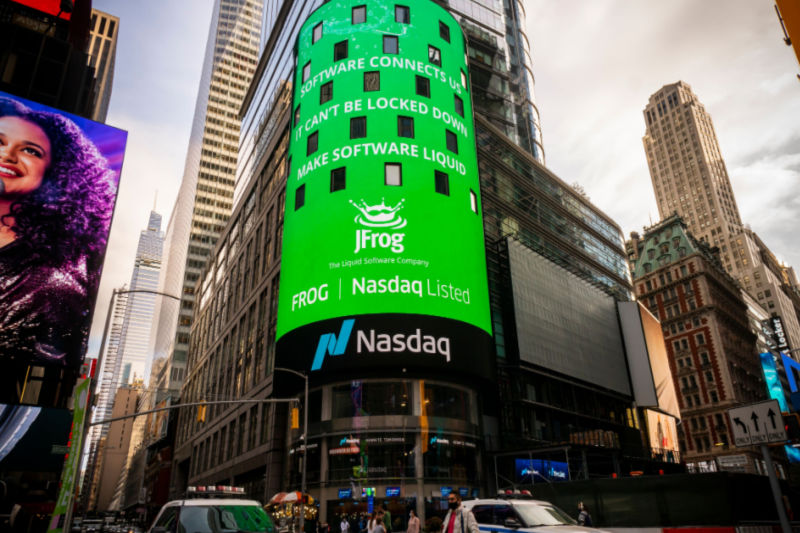
Guggenheim initiated coverage on JFrog with a Buy rating and $60 price target, citing 2025 cloud growth accelerating to 45% (total revenue +24%) and free cash flow margin expanding to 27%; shares are down 31% YTD. The firm forecasts 43% cloud growth in 2026, 25% total revenue growth and a 21% operating margin, and values JFrog at 10x EV/NTM revenue and 30x FCF (vs current 6.8x and 19.4x). JFrog also announced a $300M share buyback funded from $700M cash reserves; TD Cowen ($80 PT), Raymond James ($70 PT) and William Blair remain positive, supporting near-term investor sentiment.
JFrog sits at an under-appreciated intersection: as AI tools automate code generation they simultaneously raise enterprise demand for deterministic policy enforcement and provenance verification. That creates a structural pathway for security attach-rate expansion and margin leverage as cloud consumption scales—if the company can convert ephemeral usage into contracted, sticky enforcement revenue over 12–36 months.
Second-order winners include vendors and integrators that stitch enforcement into CI/CD pipelines and SIEMs (increasing spend per customer), while narrow point-tool security startups that lack deep control-plane integrations are most exposed. Hyperscalers represent both a demand amplifier (by shipping more managed workloads) and an existential product-bundling risk if they choose to incorporate enforcement features — timeline for meaningful bundling is 12–24 months and will vary by enterprise procurement inertia.
Key catalysts to watch are material enterprise multi-year contracts, demonstrable increases in security attach rates and sustained supply-chain incidents that force corporate boards to reallocate budgets to enforcement. The main tail risks are AI vendors packaging enforcement primitives (compressing price), a headline customer churn event, or macro-driven IT freezes that expose the name to a 30–40% downside within 6–12 months.
Positioning should be convex: reduce execution risk via staged accumulation on weakness and hedge structural AI-bundling risk. Active risk management — using options or pair-hedges — buys time for the multi-year thesis to play out while protecting against a rapid rerating driven by product bundling or customer losses.
AI-powered research, real-time alerts, and portfolio analytics for institutional investors.
Request DemoOverall Sentiment
moderately positive
Sentiment Score
0.40
Ticker Sentiment
