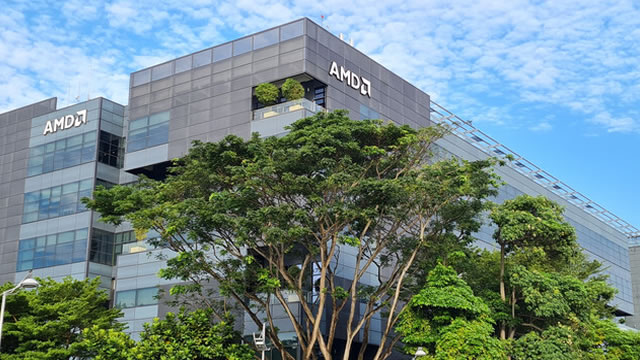
AMD was upgraded to Buy as Data Center revenue jumped 107% YoY, now representing 58% of total revenue. The firm cites an AI infrastructure “flywheel” from EPYC, Instinct, and Helios that should deepen customer relationships and expand the addressable market. Improved earnings visibility points to $15+ EPS in 2027 (with upside to >$20), which supports the current valuation and underpins a positive outlook for shares.
The important signal is not just revenue acceleration; it is that the mix shift toward data center makes AMD more “consensus defensible” in estimates and less exposed to PC replacement-cycle volatility. That usually supports a higher terminal multiple only if gross margin and operating leverage track the mix improvement; otherwise the market eventually treats it as low-quality growth. Near term, the stock can keep re-rating on upward EPS revisions, but the cleaner catalyst is whether management uses the next guide to show that AI infrastructure is becoming a durable share-gain story rather than a one-quarter order pull-forward.
Second-order winners are the adjacent suppliers and ecosystem names that sell into AMD deployment, but the biggest competitive read-through is to Intel and to a lesser extent custom-ASIC alternatives. If hyperscalers view AMD as a credible second source, it pressures incumbent pricing across server CPUs and forces competitors to spend more aggressively to defend sockets, which is margin-negative for weaker players. The flip side is that if AI customers keep concentrating spend in a small number of preferred architectures, AMD can benefit from design-win optics without capturing outsized economics, limiting upside to revenue rather than profitability.
The main risk is that the market is extrapolating a 2027 earnings path before the AI capex cycle proves durable. Any sign of inventory digestion, delayed Helios ramp, or slower-than-expected Instinct attachment would hit the multiple first and the numbers later. Over 1-3 months, the key falsifier is guidance: if data center growth normalizes sharply or gross margin fails to expand, the stock becomes vulnerable to de-rating even if revenues remain strong. Over 6-18 months, the contrarian concern is that consensus may be underestimating competitive substitution from Nvidia’s ecosystem and hyperscaler internal silicon, which could cap AMD’s long-run share gains.
AI-powered research, real-time alerts, and portfolio analytics for institutional investors.
Request DemoOverall Sentiment
moderately positive
Sentiment Score
0.60
Ticker Sentiment
