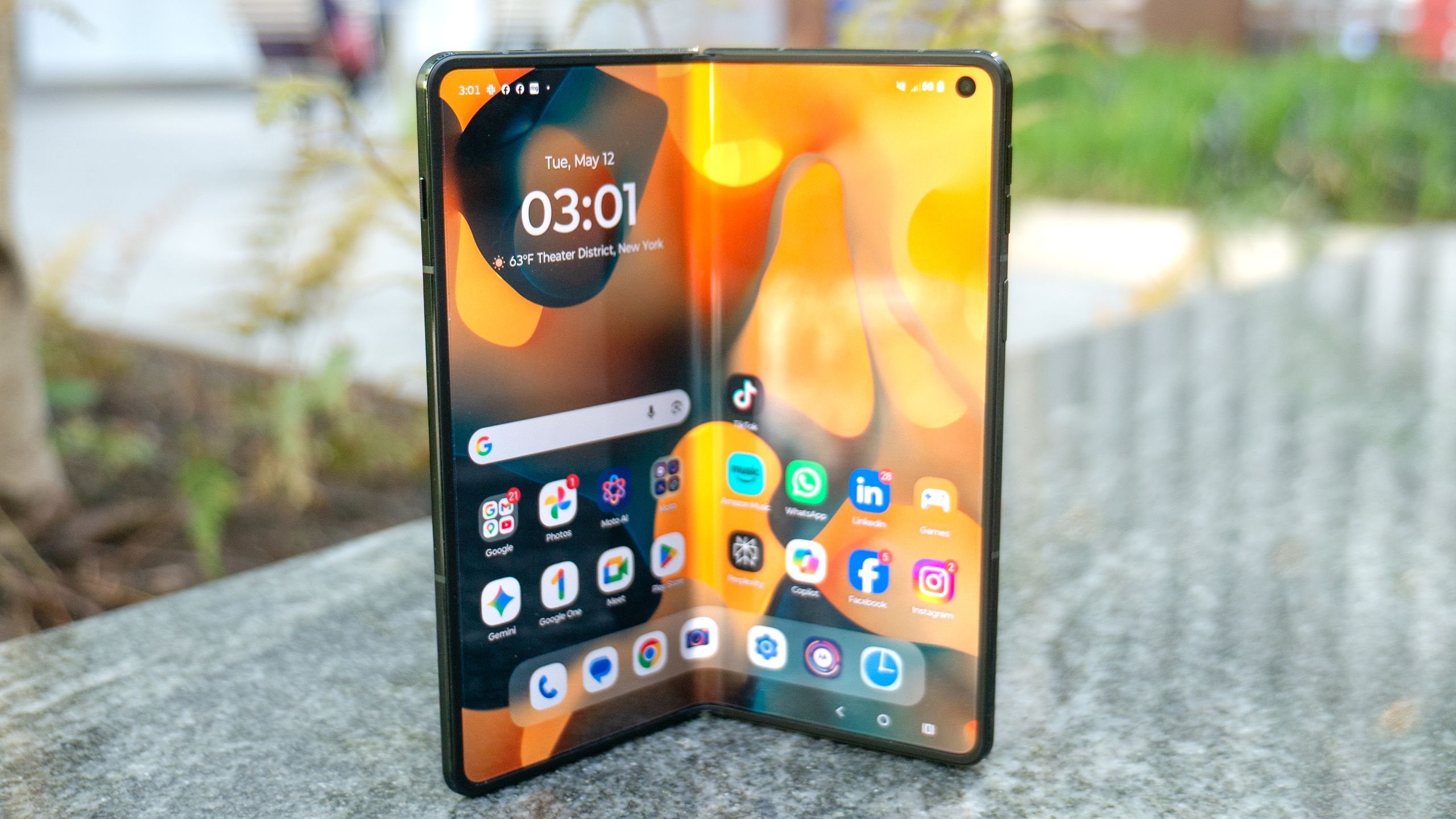
Motorola’s Razr Fold set a new battery-life record for notebook-style foldables in Tom’s Guide testing, lasting 14 hours 44 minutes on a 6,000 mAh battery. It outlasted the Galaxy Z Fold 7 by nearly 4 hours and beat the Pixel 10 Pro Fold and OnePlus Open as well, supporting the claim that Motorola has delivered a best-in-class first-generation foldable. The piece is favorable for Motorola’s product positioning but is unlikely to be a major market mover.
The key takeaway is not just that Motorola built a better foldable battery, but that it narrowed the structural disadvantage that has kept book-style foldables from competing with premium slabs on daily usability. That matters because battery anxiety has been the biggest friction point for mainstream adoption; once endurance clears the “all-day plus cushion” threshold, the category starts competing on form factor, cameras, and software rather than compromise. The second-order implication is that the best hardware now comes from a company without the ecosystem lock-in of Apple or Samsung, which raises the bar for incumbents that have been relying on brand and feature breadth to defend premium share.
For Apple, this is incrementally relevant rather than immediately financial, but it is strategically important. A credible battery benchmark in a foldable form factor makes delay risk more expensive: the longer Apple waits, the more the market will price in a mature category standard that Apple has not yet participated in. If foldables can now deliver “slab-like” endurance, then the remaining gating factors become hinge reliability, software continuity, and price compression — all areas where Apple’s eventual entry could catalyze a fast-share grab, but also where its absence leaves the narrative open to Samsung and Motorola to define the category.
The contrarian read is that battery leadership alone may not convert into unit share leadership. Foldables still face a brutal elasticity problem: consumers may admire the engineering but balk at paying a large premium for a device that remains functionally similar to a flagship slab for most tasks. In the near term, the stock-relevant impact is mostly sentiment-driven and likely limited to supplier read-throughs and category halo effects, not a direct model revision for Apple. The bigger risk to the bullish foldable narrative is if real-world battery results compress only under lighter tests, while heavier on-device AI, camera, and multitasking workloads erode the advantage in actual use over the next 6-12 months.
AI-powered research, real-time alerts, and portfolio analytics for institutional investors.
Request DemoOverall Sentiment
moderately positive
Sentiment Score
0.55
Ticker Sentiment
