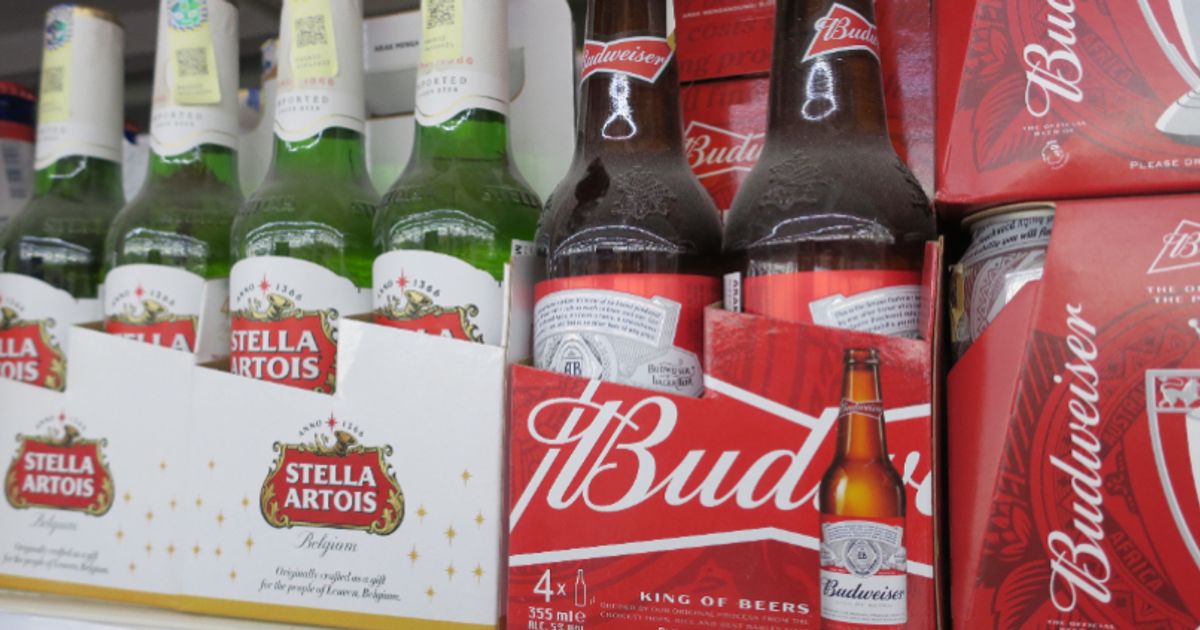
Anheuser-Busch InBev reported Q4 underlying EPS of $0.95, up 7.5% and beating the $0.92 consensus, while revenue rose 4.8% to $15.56 billion, narrowly missing the $15.58 billion estimate. Beer volumes declined 1.9% in Q4 (total volumes -1.5%) and full-year volumes were down 2.3%, though full-year EPS rose to $3.73 and organic revenue increased 2% aided by a 4.4% rise in revenue per hectoliter; reported FY revenue fell 0.8% to $59.32 billion due to unfavorable FX. Management flagged 2026 global sporting events as potential demand catalysts; shares traded up about 5% post-results, reflecting investor focus on pricing, premiumization and volume trends.
Market structure: AB InBev (BUD) is trading as a cash-flow-rich global brewer with shrinking unit volumes (beer volumes -2.6% FY, -1.9% Q4) offset by pricing/premiumization (revenue/hl +4.4%, organic rev +2%). Winners are premium brands, large-cap brewers with price-setting power and off-trade distribution partners; losers are value mainstream SKUs, smaller craft brewers reliant on on-trade footfall, and on-trade operators in discretionary markets. Cross-asset: continued volume softness creates modest credit risk widening if trends persist (watch BUD IG spreads); commodities (barley, hops) exposure is low-impact near term; FX remains a P&L swing factor given -0.8% reported revenue effect.
Risk assessment: Near-term (days–weeks) risk is mean reversion after the 5% pop; short-term (3–6 months) catalyst is the 2026 global sports calendar (peak demand in Jun–Jul) which could add 3–8% incremental volume in key markets if marketing converts. Tail risks include alcohol excise hikes, on-trade retrenchment, or rapid elasticity to price increases leading to >5% incremental volume decline; longer-term (years) secular decline in beer consumption requires structural margin adjustments. Hidden dependency: recovery is concentrated in specific markets (US/LatAm/EM) and sensitive to FX and trade channel mix shifts.
Trade implications: Tactical directional: BUD is event- and execution-driven — exploit event upside and margin resilience but hedge secular volume risk. Use spread/paired exposure to limit FX/cycle noise (long regional peer, short BUD) and employ option structures around World Cup (Jun–Jul 2026) to capture asymmetric upside while limiting downside. Rotate modest weight from non-premium beverage cyclicals into resilient premium alcohol names and selective on-trade recovery plays over next 3–12 months.
Contrarian angles: The market underrates the elasticity risk of continued price increases — premiumization can hit a ceiling in cost-of-living stressed markets; the post-earnings 5% rally may be overdone if volumes do not budge by Q2 guidance. Historical parallel: post-event demand bounces (e.g., 2014/2018 sports cycles) produced short-lived volume spikes that reverted within 6–9 months absent sustainable mix change. Watch retail POS (Nielsen), on-trade footfall, and monthly volume prints for 2 consecutive months before scaling positions.
AI-powered research, real-time alerts, and portfolio analytics for institutional investors.
Request DemoOverall Sentiment
mixed
Sentiment Score
0.10
Ticker Sentiment
