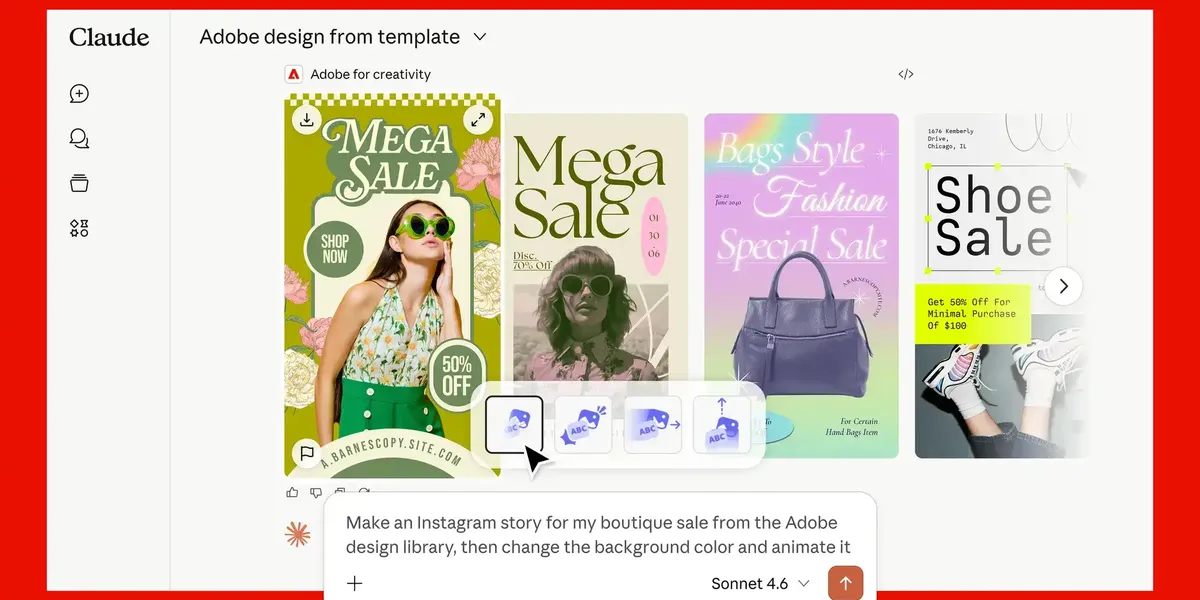
Adobe launched a new "creativity connector" with Anthropic that lets Claude orchestrate multi-step workflows across 50+ Creative Cloud tools, including Photoshop, Illustrator, Premiere, Lightroom, InDesign, and Stock. The connector is positioned to speed up asset creation, photo editing, and video repurposing, though the AI features are still being tested and adoption will depend on user opt-in via Claude and Adobe accounts. The announcement is strategically positive for Adobe and Anthropic, but near-term market impact appears limited.
This is less a product launch than a distribution moat event. Adobe is turning its installed base into the default execution layer for agentic creative workflows, which should increase switching costs and reduce the odds that standalone AI copilots capture the creator workflow at the application layer. The second-order winner is not just Adobe's core subscription base, but also its adjacent monetization stack: more usage intensity can lift attach rates for Firefly, asset storage, collaboration, and enterprise seats over the next 2-6 quarters.
The more interesting competitive effect is on workflow fragmentation. If Claude becomes the orchestration front-end while Adobe remains the transaction layer, the market may wrongly assume this is a zero-sum AI threat to Adobe when it is actually a way to preserve pricing power while ceding interface control. That said, the upside for Adobe is likely incremental rather than explosive because this feature is initially a productivity enhancer, not a full substitution of human creative judgment; the revenue inflection should lag product enthusiasm by at least 1-2 reporting cycles.
For Autodesk, the read-through is neutral to mildly positive: agentic connectors validate the broader design-software category, but also raise the bar for any pure-workflow vendor that lacks proprietary content, distribution, or model partnerships. The main risk is reputational and legal: if AI-generated outputs create quality issues, IP disputes, or brand damage, adoption could stall quickly, and enterprises may cap usage before meaningful monetization emerges. The contrarian take is that the market may overestimate near-term displacement risk to creatives and underestimate how much AI increases software consumption per user, especially in enterprise media, marketing, and e-commerce teams.
AI-powered research, real-time alerts, and portfolio analytics for institutional investors.
Request DemoOverall Sentiment
mildly positive
Sentiment Score
0.15
Ticker Sentiment
