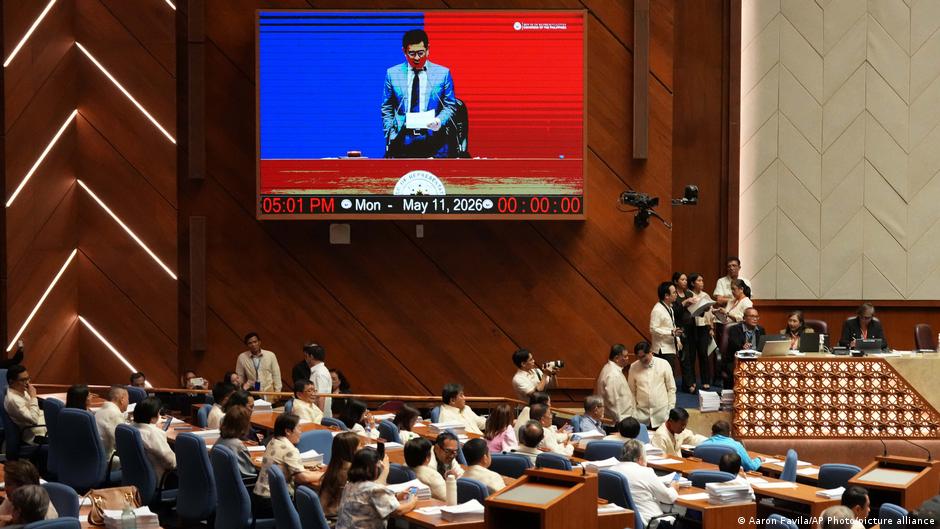
Philippine lawmakers voted 255 to 26, with 9 abstentions, to advance impeachment proceedings against Vice President Sara Duterte, sending the case to a Senate trial. The articles cite alleged misappropriation of public funds, unexplained assets, bribery, and a reported death threat against President Ferdinand Marcos. The move is an early setback for Duterte's potential 2028 presidential bid and follows a prior impeachment attempt that was blocked on procedural grounds.
This is a classic governance shock with limited immediate asset-level impact but meaningful distributional effects on Philippine political risk. The market should think less about the impeachment itself and more about whether it fractures the ruling coalition ahead of the next budget cycle and the 2028 succession path. That matters for sectors that trade on policy continuity — banks, infrastructure, utilities, and domestically focused property names — because even a non-final conviction can slow approvals, delay fiscal execution, and raise the political premium on local assets.
The second-order winner is President Marcos’s camp if it can convert this into a clean anti-corruption narrative; that would strengthen control over cabinet appointments and legislative bargaining. The loser is any asset priced off a stable Duterte brand or regional patronage network, especially where local permitting and procurement matter. The more interesting read-through is to credit quality: prolonged institutional conflict often widens sovereign and corporate spreads before anything fundamental changes, as investors demand compensation for policy slippage and headline risk.
Catalyst timing is asymmetric. In days to weeks, volatility should be driven by Senate procedural developments and any fresh revelations that widen the case; in months, the key risk is whether the proceeding becomes a proxy battle that drags on through budget negotiations. The contrarian view is that this may be over-read as a regime-risk event: a failed or slow-moving impeachment could ultimately reinforce institutions, reduce uncertainty, and compress risk premia faster than consensus expects. The biggest tail risk is not conviction itself, but retaliatory polarization that makes governance less predictable across the 12-18 month horizon.
AI-powered research, real-time alerts, and portfolio analytics for institutional investors.
Request DemoOverall Sentiment
moderately negative
Sentiment Score
-0.35
