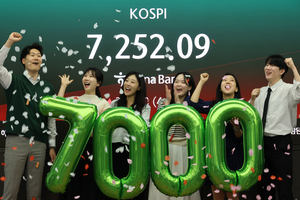
South Korea's Kospi opened above 7,000 for the first time, starting at 7,093.01 and briefly surging to 7,311.54, as easing Middle East tensions and falling oil prices fueled a broad risk-on rally. The move triggered a buy-side sidecar about six minutes into trading after Kospi 200 futures jumped more than 5%, marking the eighth such halt this year. Samsung Electronics topped 250,000 won and SK hynix broke above 1.6 million won, while U.S. equities also hit records overnight.
This is not just a momentum print; it is a positioning event. When an index can gap through a psychologically clean round number and trigger circuit-breaker style selling constraints on the way up, the marginal buyer is no longer discretionary capital but forced flow chasing a higher volatility regime. That tends to extend for days, not weeks, until breadth narrows and profit-taking in the biggest weight names becomes large enough to absorb systematic demand.
The clearest second-order winner is the domestic brokerage and market infrastructure complex, not the headline index constituents. Elevated turnover, call activity, and repeated sidecar events usually lift transaction revenue, but the real trade is in firms with high operating leverage to retail participation and derivatives volume; if this becomes a multi-week melt-up, fee tails can matter more than asset gains. On the flip side, exporters without direct AI/semiconductor exposure may underperform the index because the rally is increasingly concentrated in a handful of winners, creating internal rotation risk even as the benchmark rises.
The main risk is that this is becoming a crowded geopolitics-and-liquidity overlay trade: the market is effectively pricing a benign oil path, stable rates, and uninterrupted risk appetite all at once. Any re-acceleration in crude, a headline on regional conflict, or a modest USD move against the won could force a fast de-grossing because leverage is now embedded in the chase. The move can absolutely persist, but the asymmetric reversal risk is highest if chip leadership stalls for even one session after such an extreme multi-month run.
Contrarianly, the market may be underestimating how much of the upside has already been pulled forward into the most liquid names. When a benchmark moves this far this fast, subsequent alpha often comes from shorting the laggards that were dragged up by index optics rather than fighting the flagship names outright. In other words, the better expression may be relative-value, not naked index shorting.
AI-powered research, real-time alerts, and portfolio analytics for institutional investors.
Request DemoOverall Sentiment
strongly positive
Sentiment Score
0.70
Ticker Sentiment
