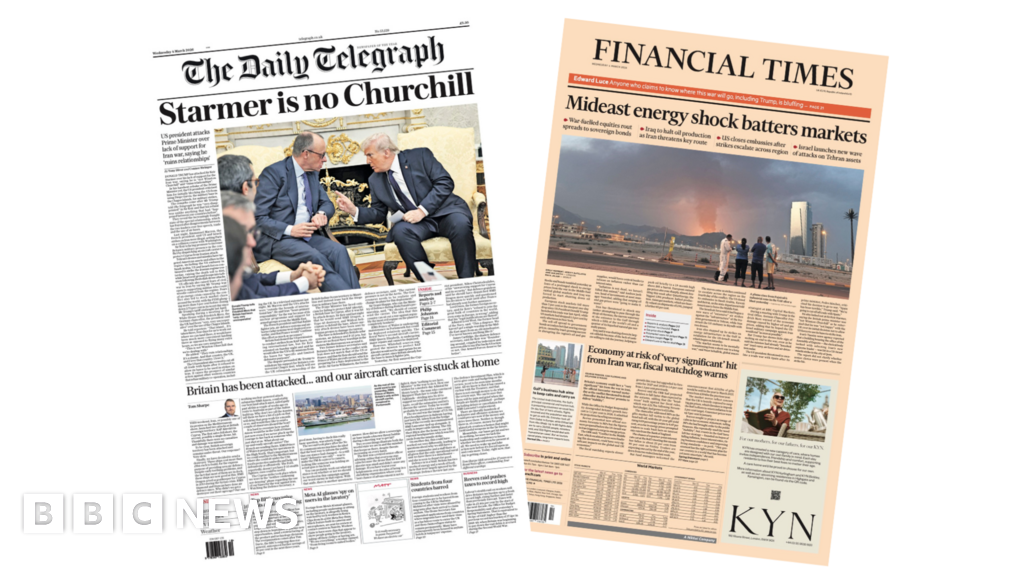
Escalating US and Israeli strikes on Iran and subsequent Iranian counterthreats have rattled markets, with the Financial Times noting a c.3% fall in European equities and closures of Iraqi oilfields amid tanker threats through the Strait of Hormuz. Energy supply concerns have driven surging fuel prices and forecourt disruption, while RBC strategists say markets appear to be pricing a shift from a short to a potentially prolonged conflict—raising downside risk for risk assets, upward pressure on oil and defense-related sectors, and prompting risk-off positioning among investors.
Market structure: Immediate winners are large integrated oil & gas producers and energy services (US majors and XLE constituents) plus defense primes and marine insurers; losers are short-cycle travel/cargo-exposed sectors (airlines, cruise) and European cyclical equities (FTSE/Eurostoxx at risk after the reported -3% drop). A physical choke point risk through the Strait of Hormuz (carries ~20% of seaborne oil) and Iraq field closures could remove an estimated 1–3 mbpd of supply near-term, boosting Brent volatility and refining margins.
Risk assessment: Tail scenarios include a sustained blockade, attacks on Gulf infrastructure, or widening US/UK direct involvement — each could spike oil +30–60% and widen credit spreads by 50–150bp for EM/European banks. Immediate (days) expect VIX and oil vol to jump; short-term (weeks–months) expect tactical SPR releases and higher US shale response capping peaks; long-term (quarters–years) political realignment could permanently re-rate defense and energy capex. Hidden dependencies: shipping-insurance premiums, rerouting costs, and refining bottlenecks amplify pass-through to consumer fuel prices.
Trade implications: Tactical overweight energy via XLE and Brent exposure (BNO or targeted Brent call-spreads) for 1–3 month horizons while buying protection in equities (1–2% portfolio in VIX call spreads or 3–6 month 25-delta SPX puts). Long defense primes (LMT, RTX) with 6–12 month hold; short airlines (AAL, DAL) or European leisure operators relative to energy to capture asymmetric pain. Use clear triggers: add energy exposure if Brent > +10% intraday or VIX >25; cut after 20–30% realized oil move or 90 days.
Contrarian angles: Markets may be overstating a permanent supply shock — US shale can add ~0.5–1 mbpd in 3–6 months if prices sustain >$80–85/bbl, making long-dated oil positions vulnerable. Historical parallels (2019 tanker strikes, limited escalation episodes) show swift mean reversion; consider fading near-term rallies in 6–12 month Brent futures via calendar spreads. Also, higher near-term oil could accelerate renewables/strategic inventory policies, capping long-term oil upside.
AI-powered research, real-time alerts, and portfolio analytics for institutional investors.
Request TrialOverall Sentiment
moderately negative
Sentiment Score
-0.60
