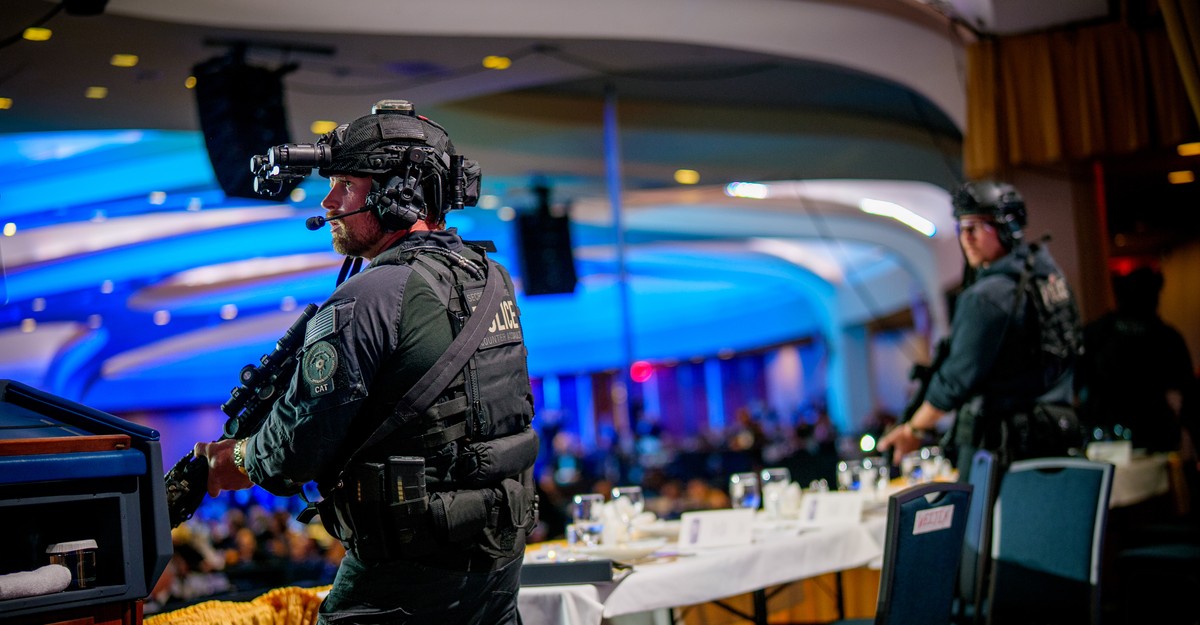
An attempted attack near the White House Correspondents’ Association dinner was foiled, with only a minor injury reported to a Secret Service officer. The article argues against overreacting with sweeping security changes, warning that hardening public events, trains, or presidential venues into fortress-like spaces would erode open society more than it would improve safety. The market impact is limited and mostly policy/opinion-related rather than directly financial.
The market implication is not a direct security spend windfall; it is a gradual re-rating of how much friction the public sector can add before commerce and mobility get impaired. The first-order beneficiaries are vendors that sell perimeter, identity, and access-control layers to government and large venues, but the more durable trade is in firms that help institutions reduce screening costs without turning spaces into airports. That favors software-led security over labor-heavy guarding, because the marginal response after an incident is usually headcount and process changes, which are politically visible but operationally weak.
The real second-order risk is legislative overreach into transportation and venue operations. If lawmakers or agencies respond with even modestly tighter screening on rail, hotels, or public events, the cost burden falls disproportionately on operators with thin margins and low pricing power: railroads, event venues, hotel REITs, and transit-adjacent services. The macro effect is small in GDP terms, but the margin impact can be meaningful because these businesses absorb compliance costs faster than they can reprice tickets or rooms.
A more interesting contrarian setup is that the headline pushes policymakers toward visible, low-ROI security theater rather than the less visible fixes that actually improve outcomes. That means the strongest beneficiaries may underperform on the event because investors know the political cycle tends to produce consultants, contractors, and compliance tooling before it produces durable capex. Conversely, any reversal in tone after the news cycle fades should quickly deflate the “security spend” bid, making this a short-lived thematic rather than a structural one.
From a timing perspective, the trade is days-to-weeks on sentiment and months on procurement. The tail risk is a genuine policy pivot after a second incident, which would broaden the spend basket from niche security names into transportation screening and facility hardening. Absent that, the more probable path is cosmetic tightening, a brief rally in defense/security contractors, and then mean reversion once investors realize the budgetary response will be incremental rather than transformative.
AI-powered research, real-time alerts, and portfolio analytics for institutional investors.
Request DemoOverall Sentiment
neutral
Sentiment Score
-0.05
