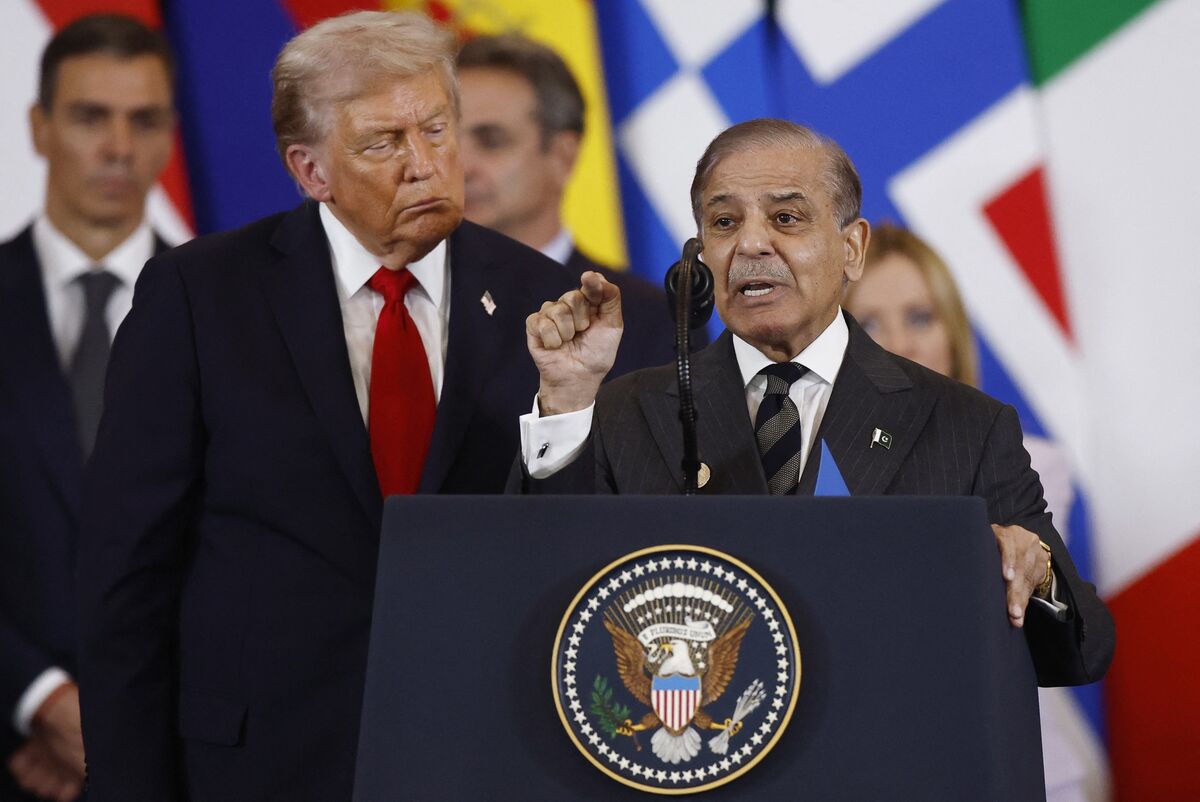
Key event: Pakistan has been publicly lauded by President Trump and other global officials as a peacemaker in the US-Israel war against Iran. India, which has spent nearly a year trying to brand Pakistan as a state sponsor of terrorism after a brief armed conflict, has seen that message gain little traction and is watching Islamabad’s diplomatic rehabilitation warily.
Diplomatic normalization of a previously isolated regional actor rewrites near‑term political risk premia across South Asia. The immediate winners are suppliers and financiers who can credibly scale up arms sales, reconstruction contracts and balance‑of‑payments support within 3–12 months; losers are exporters and risk‑sensitive Indian assets that price in heightened political uncertainty and potential capital flight. Expect a second‑order shift: acceleration of India’s indigenization push will favor domestic capital goods, precision machining and electronics suppliers (local content rises), while global primes with existing India relationships capture near‑term order flow.
Key catalysts and time horizons are distinct: headline moves (days–weeks) will drive FX and equity volatility, while contract awards, IMF/aid tranches and parliamentary elections determine medium (3–12 months) and long (12–36 months) outcomes. Tail risks include a retaliatory kinetic incident or reversal of diplomatic cover that would snap spreads wider and re‑isolate the actor; probability of that materially rising is event‑driven and clustered around military incidents or surprise policy shifts. Watch sovereign CDS and 2–5 year bond issuance cadence as high‑signal near‑term indicators.
The consensus frames this as a purely geopolitical win for stability; the overlooked dynamics are fiscal and industrial. If recognition unlocks financing, sovereign risk compression will attract frontier investors but also permit the partner to import higher‑end weaponry—forcing India to accelerate domestic procurement and capex, which benefits capital‑goods chains but raises inflationary pressures and fiscal trade‑offs. That creates asymmetric payoffs: equipment suppliers and exporters of defence‑grade components stand to gain over general consumer cyclical exposure in India.
AI-powered research, real-time alerts, and portfolio analytics for institutional investors.
Overall Sentiment
neutral
Sentiment Score
0.00
