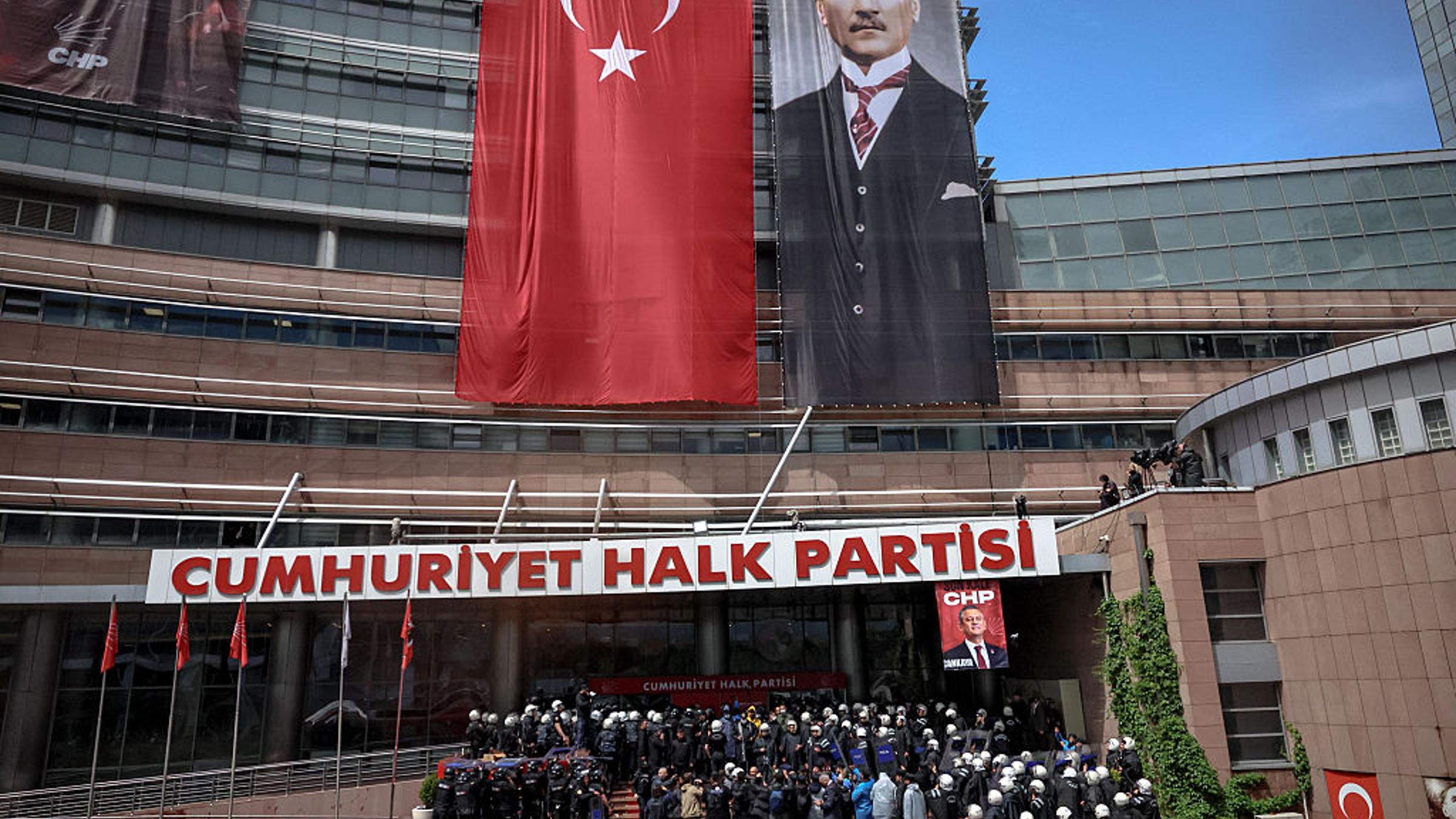
Türkiye’s main opposition CHP faced a court-backed leadership upheaval and police eviction at its Ankara headquarters, with tear gas and rubber bullets used to enforce the ruling. A Turkish appeals court nullified Özgür Özel’s 2023 election as party chair and provisionally reinstated Kemal Kılıçdaroğlu, intensifying political instability ahead of any potential early election. The episode heightens concerns about democratic backsliding and could increase near-term policy and market volatility in Türkiye.
The key market implication is not a one-day political headline but a step-change in institutional discount rates for Türkiye. When legal rulings can be operationalized through police action inside a major opposition party’s headquarters, investors should assume a higher probability of policy discontinuity, weaker property-rights enforcement, and a larger equity risk premium across domestic assets. That tends to hit the long-duration part of the market first: banks, consumer discretionary, real estate, and any levered balance-sheet story tied to stable domestic demand.
Second-order, the ruling party may actually be setting up a cleaner electoral path by forcing fragmentation inside the opposition. That can be superficially positive for incumbency odds, but it is negative for asset prices because it raises the odds of heavier administrative intervention, more protests, and broader sanctions risk from western institutions if repression escalates. The near-term catalyst is not a formal election, but whether the opposition responds with sustained street mobilization or whether factionalism blunts the challenge over the next 2-8 weeks.
The contrarian angle is that the selloff may be too blunt if markets assume immediate macro collapse. Erdoğan’s base case remains capital-controls-lite stabilization: keep growth low but positive, preserve access to external funding, and avoid a balance-of-payments event. If that holds, the best relative short may be versus domestically exposed cyclicals rather than the whole country, because exporters with hard-currency revenues can outperform even in a worsening political tape.
For risk management, the tail risk is a rapid break in confidence that forces renewed FX pressure and policy tightening, which would spill into banks within days and into credit spreads over months. The reversal trigger is either a negotiated party reset that lowers protest intensity or a deliberate move toward early elections that temporarily restores political optionality.
AI-powered research, real-time alerts, and portfolio analytics for institutional investors.
Request DemoOverall Sentiment
strongly negative
Sentiment Score
-0.60
