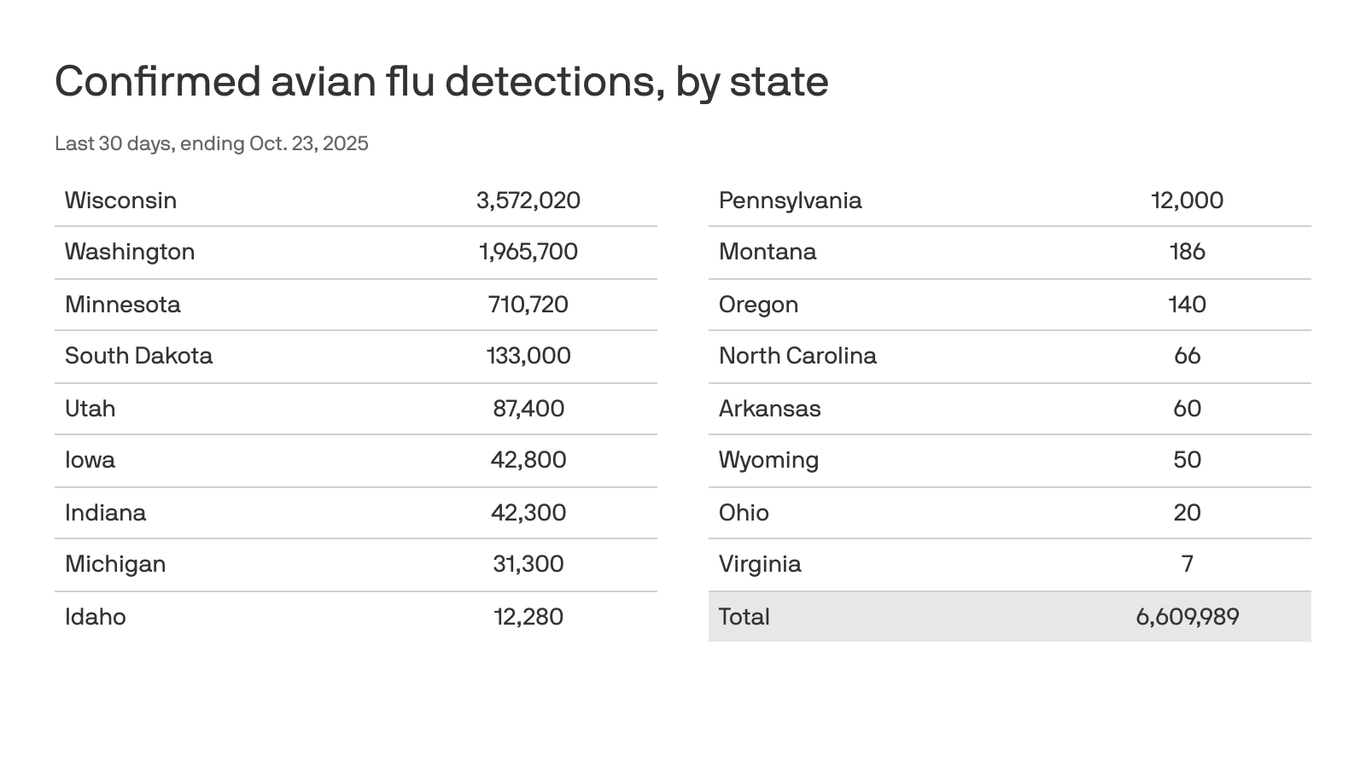
Washington state recently reported nearly 2 million bird flu cases from a single commercial facility, contributing to a nationwide total of 6.6 million birds affected across 17 states between late September and late October. This H5N1 outbreak, driven by migratory birds, presents an immediate concern for rising food and egg prices, despite a prior $1 billion allocation for biosecurity and farmer relief. The evolving nature of the virus and a slowed federal response due to staffing cuts underscore ongoing risks to the poultry industry and potential broader economic impacts, though the immediate human health risk remains low.
Washington state recorded nearly 2 million bird flu (H5N1) cases in October from a single commercial facility, contributing significantly to the 6.6 million birds affected nationwide across 17 states between late September and late October. This surge, driven by migratory bird routes, positions Washington with the country's second-highest recent case count. The rapid spread underscores an ongoing threat to domestic poultry operations.
The primary immediate concern stemming from this outbreak is the potential for increased food prices, particularly for eggs, despite a prior $1 billion allocation in February for biosecurity audits and farmer relief. This funding aimed to curb rising egg prices, but the current situation suggests persistent inflationary pressures within the commodities sector. The H5N1 virus continues to evolve, posing a sustained risk to agricultural supply chains.
Compounding the challenge, staff cuts at the CDC and USDA, alongside a government shutdown, have reportedly slowed the federal response, hindering crucial inter-agency coordination. This diminished response capacity, coupled with expert uncertainty regarding the U.S. approach, elevates the risk profile for the poultry industry. While direct human health risk remains low, the scale of the outbreak signals potential broader economic and public health implications if the virus continues to spread and evolve.
AI-powered research, real-time alerts, and portfolio analytics for institutional investors.
Overall Sentiment
strongly negative
Sentiment Score
-0.65
