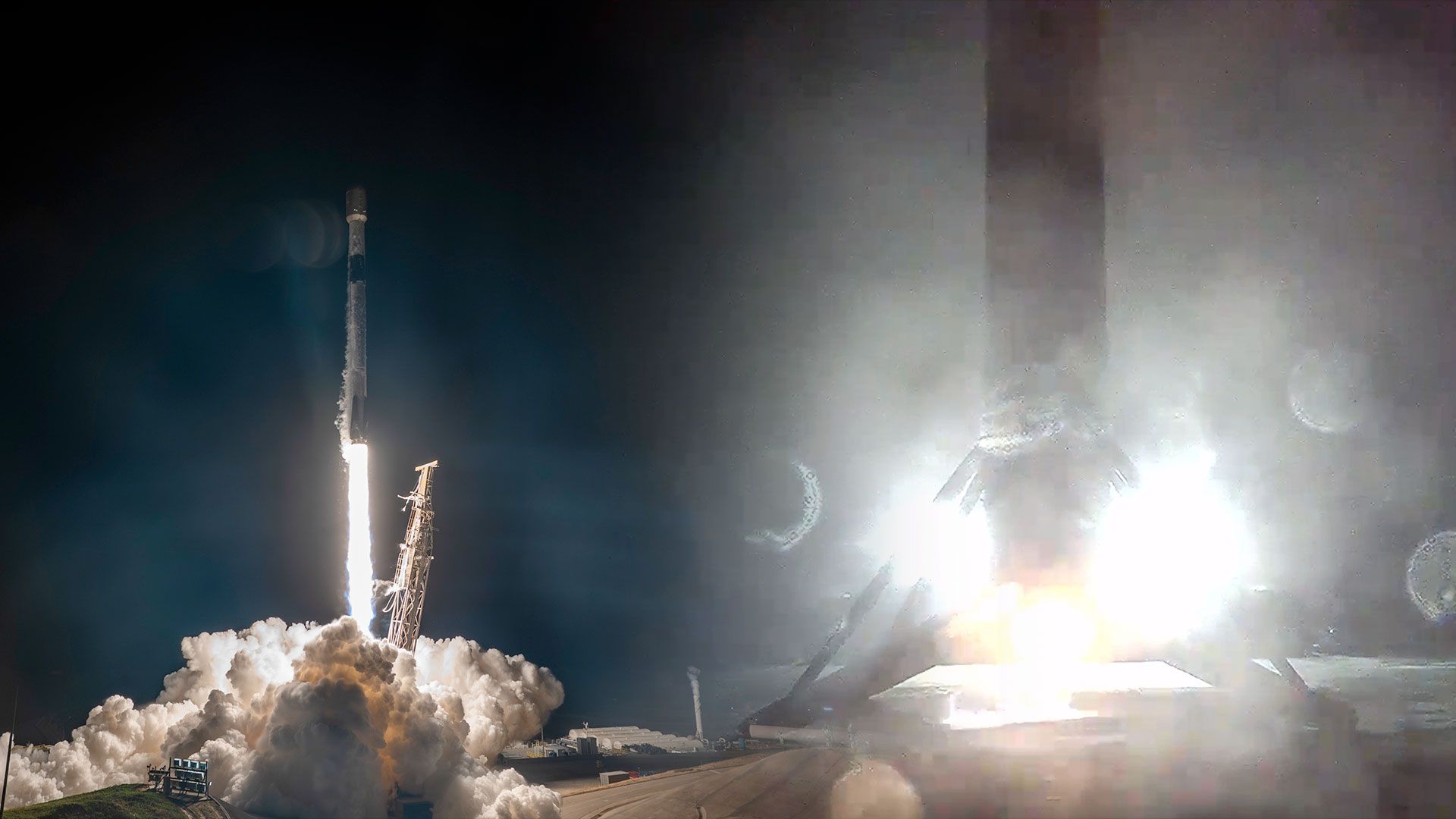
SpaceX launched two Falcon 9 missions on Feb. 21, lofting 25 Starlink satellites from Vandenberg on booster B1063 (its 31st flight) and 28 satellites from Cape Canaveral on booster B1067, which completed a record 33rd reflight. Both missions reached orbit with first stages landing on droneships Of Course I Still Love You and A Shortfall of Gravitas; the 53 satellites bring SpaceX's active Starlink constellation to over ~9,700 units and mark the company's 21st and 22nd Falcon 9 launches of the year. The 33rd reuse milestone underscores continued operational efficiency and potential unit-cost advantages for SpaceX's launch and broadband businesses, though the update is primarily operational rather than a direct market-moving financial event.
Market structure: SpaceX’s 33rd reflight materially lowers its marginal launch cost and strengthens de facto pricing power in LEO launch and broadband distribution. Expect downward pressure on public small-launch providers’ revenue per manifest (20–40% squeeze plausible over 12–36 months) and acute margin compression for firms that can’t match surge cadence or vertical integration.
Risk assessment: Tail risks include regulatory bans or national security restrictions (country-level rollbacks within 30–180 days), a major on-orbit collision raising insurance premiums (shock within 0–12 months), or US export/spectrum curbs; any of these could reverse competitive advantages. Short-term event risk is low, but over 3–5 years the buildout cadence and regulatory outcomes drive valuation delta of 30%+ for exposed names.
Trade implications: Favor suppliers of ground terminals, SSA and defense-related space services that benefit from high constellation density (6–24 month horizon) and underweight/hedge pure-play launch peers and legacy GEO ISPs. Use directional equity and option structures to express asymmetric views: buy calls on resilient suppliers and buy puts or put spreads on launch-competitor equities; size initial positions 1–3% NAV and reprice on key catalysts (quarterly launches, FCC filings).
Contrarian angles: The market’s headline reaction may be to uniformly penalize all space equities; that’s likely overdone. Second-order winners include space situational awareness (debris removal/insurance) and defense primes that capture government-funded resilience work — these names can outperform even if launch-equity indexes lag.
AI-powered research, real-time alerts, and portfolio analytics for institutional investors.
Request DemoOverall Sentiment
moderately positive
Sentiment Score
0.45
