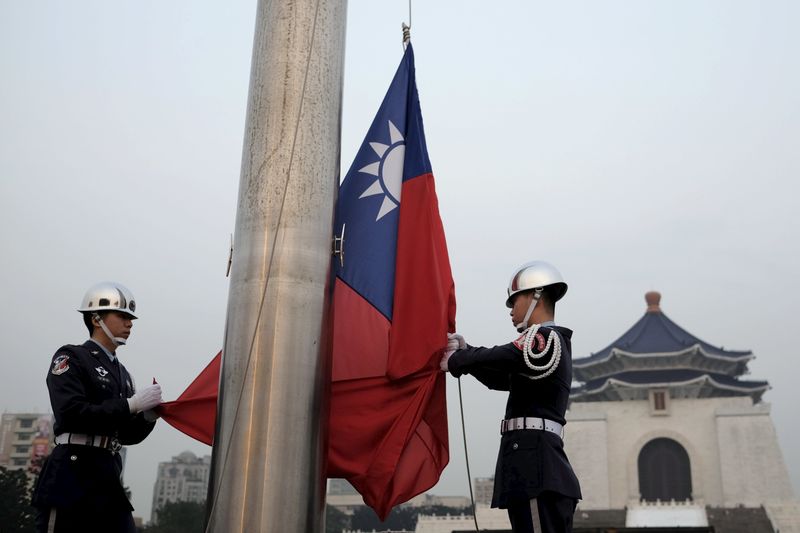
Taiwan says Beijing interfered with President Lai Ching-te’s overseas trip after flight permits were revoked in Seychelles, Mauritius, and Madagascar, forcing the first full cancellation of a Taiwanese leader’s diplomatic mission due to airspace denial. The episode escalates cross-strait tensions and highlights growing "gray zone" pressure that could disrupt regional logistics and diplomatic travel. The broader risk is heightened uncertainty for semiconductors, supply chains, and Taiwan-related assets as the U.S. and European allies criticize Beijing’s tactics.
This is less about Taiwan diplomacy than about Beijing normalizing low-cost coercion that can be scaled across air, sea, and administrative chokepoints. The market’s first-order read is geopolitical noise, but the second-order issue is route fragility: repeated transit denials raise the probability of discretionary delays for executive travel, air cargo routing, and time-sensitive semiconductor logistics even without a kinetic escalation. That matters most when supply chains are already running lean and fabs are operating with minimal buffer inventory.
For TSM, the direct earnings impact is likely negligible, which is why the stock reaction should stay muted unless the story broadens into insurance, freight, or export-control friction. The more relevant channel is valuation multiple compression: TSM is priced like a structural winner on AI/foundry demand, so any sustained premium on Taiwan geopolitical risk can shave 1-2 turns off forward P/E even if quarterly fundamentals remain intact. Suppliers and customers with more optionality may gain relative share if they can diversify packaging, testing, or final assembly outside Taiwan.
The real beneficiaries are infrastructure, defense, and logistics names tied to regional contingency planning rather than the headline semiconductor complex. Expect incremental demand for shipping reroutes, charter capacity, satellite connectivity, hardened data transport, and defense electronics as corporations pay up for resilience over the next 6-18 months. Conversely, EM travel, aviation, and insurers with Asia concentration face a slow-burn risk premium as gray-zone actions become more frequent and harder to model.
The contrarian view is that the move is still underpriced if investors assume this is purely symbolic. Beijing has learned that administrative pressure creates measurable economic drag without triggering a broad Western response, so the path of least resistance is more of it, not less. A major easing catalyst would require either a U.S.-China tactical thaw or Taiwan-aligned states explicitly resisting transit denial; absent that, the default is a higher baseline of friction into year-end.
AI-powered research, real-time alerts, and portfolio analytics for institutional investors.
Request DemoOverall Sentiment
moderately negative
Sentiment Score
-0.35
Ticker Sentiment
