


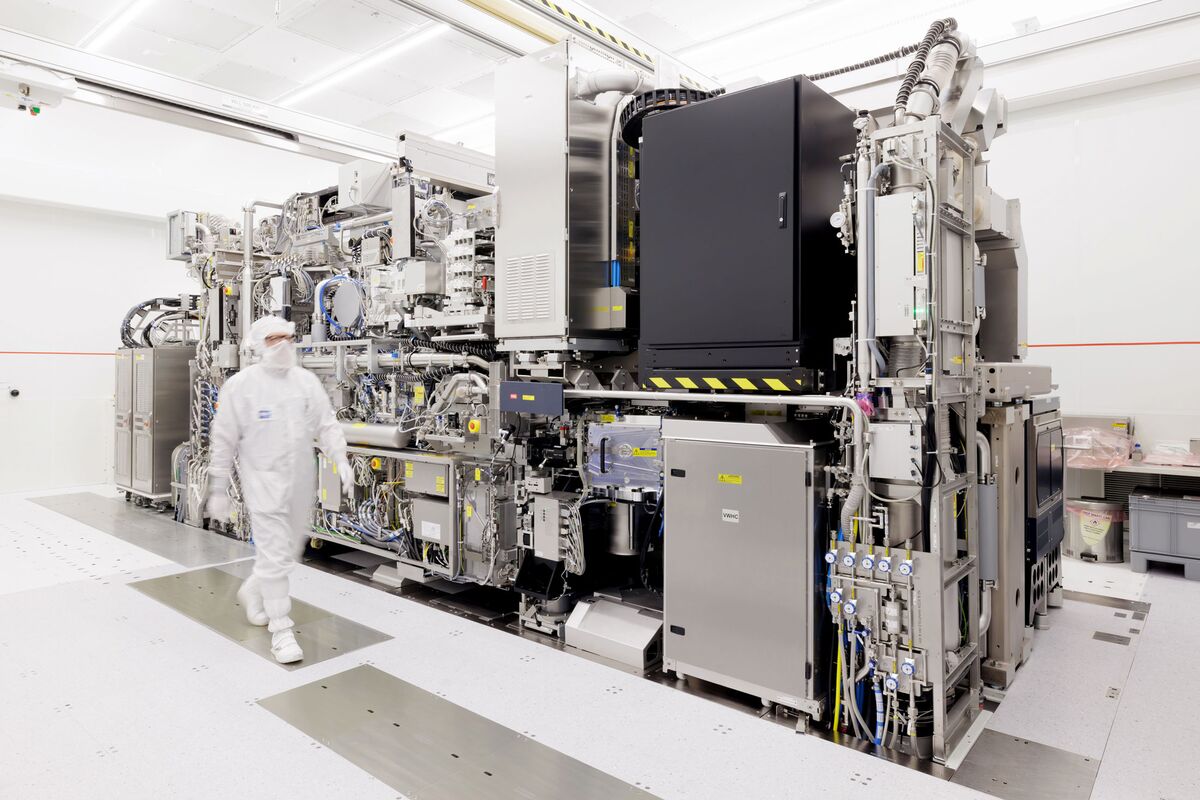
TSMC and ASML’s upcoming results are being closely watched amid a selloff in AI-inflated tech stocks, with TSMC’s planned capital expenditure and ASML’s capacity expansion roadmap expected to signal the chip industry’s pace of growth. The article frames these updates as especially important for Nvidia’s supply chain visibility, but provides no specific financial figures. Overall, the news is positioned as informative rather than decisively bullish or bearish for the near term.
The market is treating this print as a referendum on whether AI spend is decelerating or merely rotating. That matters more for ASML and the broader semi-equipment complex than for NVDA near term: if TSM is still adding front-end and advanced packaging capacity, it supports backlog durability for ASML, AMAT, LRCX, and KLAC even if the headline AI basket keeps derating. The key mechanism is not unit demand today but whether the industry is willing to commit to another 6-18 months of capacity build, which ultimately sets pricing power and supply tightness.
The first-order loser if guidance is cautious is the high-multiple AI tape itself, because any capex pause implies the hyperscaler buildout is moving from "scarcity" to "optimization." That would pressure NVDA, but also ANET and the broader AI infrastructure cohort as investors question how much of current revenue growth is pull-forward versus sustainable consumption. Conversely, if capex is firm, the contrarian winners may be the equipment names rather than the GPU leaders: they benefit from a more visible revenue runway and are less exposed to downstream multiple compression.
This is a short-horizon catalyst with a longer structural readthrough. Over days, the tape will trade on whether bookings/capex surprise up or down; over 1-3 months, the signal matters for semicap estimate revisions; over 6-18 months, it determines whether current AI supply constraints persist or begin to ease. What would falsify a bullish equipment thesis is not a modest capex pause, but a clear step-down in TSM forward spending or a deterioration in ASML backlog/order cadence that persists for two quarters.
Contrarian view: consensus may be overinterpreting headline capex as a binary on/off switch for AI. The more important variable is mix and utilization: even flat capex can still be bullish if it is concentrated in advanced nodes and packaging with strong pricing leverage. In that case, the market is likely underpricing ASML's relative resilience and overpricing NVDA's near-term upside from another quarter of supply-chain validation.
AI-powered research, real-time alerts, and portfolio analytics for institutional investors.
Request TrialOverall Sentiment
neutral
Sentiment Score
0.00
Ticker Sentiment
