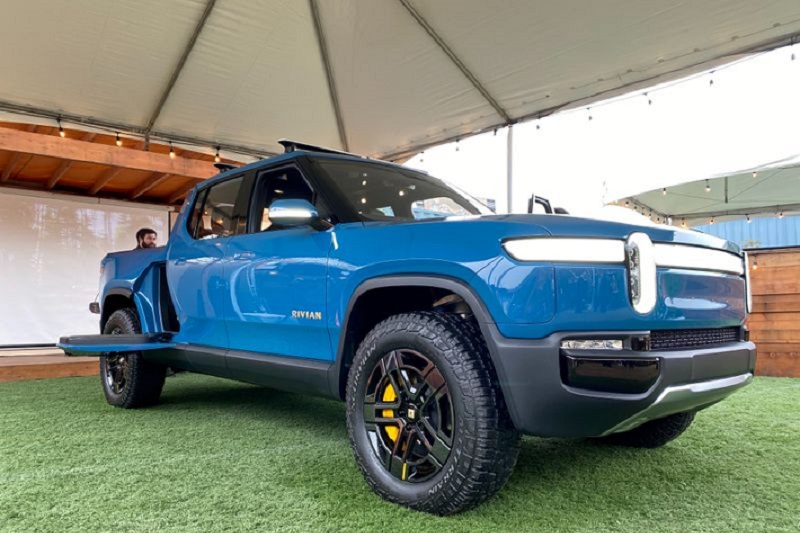
Rivian delivered Q1 EBITDA of -$472 million versus -$500 million consensus and revenue of $1.38 billion in line with expectations, but shares fell 4% in premarket trading as gross profit weakened and the beat was largely attributed to regulatory credits. The company issued 2026 guidance for 62,000-67,000 vehicle deliveries, adjusted EBITDA of a $2.10 billion to $1.80 billion loss, and capex of $1.95 billion to $2.05 billion. Rivian also lifted its Georgia plant capacity target for R2 to 300,000 units from 200,000 and said production there remains on track for late 2028.
The key market signal is not the beat itself but the quality of it: if EBITDA upside is being leaned on by regulatory credits while unit economics still deteriorate, the equity is still trading on a financing/optionality narrative rather than durable operating leverage. That tends to cap multiple expansion because the market can’t underwrite a clean bridge to self-funded growth until gross margin inflects on mix, not just on accounting items.
The raised R2 factory target is strategically important, but it’s also a subtle admission that Rivian wants to pre-commit scale before demand is proven. Higher planned capacity can improve future unit costs, yet it increases execution risk if the launch slides, because fixed-cost absorption only helps if volumes arrive on schedule. The bigger second-order read-through is for suppliers and contract manufacturers: any delay in R2 commercialization pushes more of the economics onto the commercial-van program, where mix is less favorable and pricing power is weaker.
Near term, the stock can remain range-bound because the next catalyst is not another quarter of “better-than-feared” losses, but evidence that software/services can become a meaningful gross profit offset. Over months, the strongest bull case is if Volkswagen capital and the Georgia ramp reduce perceived refinancing risk; the strongest bear case is if credit-related support normalizes downward and the market refocuses on cash burn and capex intensity. That asymmetry argues for trading the setup as a catalyst-driven volatility name rather than a clean long-duration growth story.
Consensus is likely missing that the best outcome for the stock may be slower but more credible scaling, not faster headline growth. If R2 capacity is expanded before demand is visible, the market may initially reward ambition but eventually punish dilution risk if capex rises without a matching margin inflection. In other words, the stock’s near-term upside is more dependent on narrative repair than operational proof, which usually makes rallies fragile.
AI-powered research, real-time alerts, and portfolio analytics for institutional investors.
Request DemoOverall Sentiment
mixed
Sentiment Score
0.15
Ticker Sentiment
