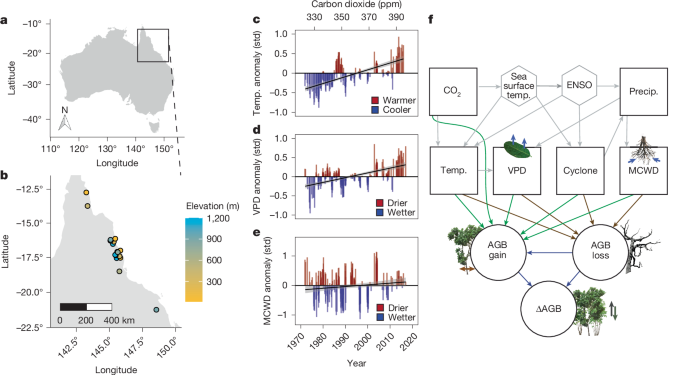
Australian moist tropical forests have transitioned from a significant carbon sink (0.62 ± 0.04 Mg C ha−1 yr−1 from 1971–2000) to a net carbon source (−0.93 ± 0.11 Mg C ha−1 yr−1 from 2010–2019), according to a new study. This critical shift, driven by extreme temperatures and climate anomalies increasing tree mortality without evidence of CO2-induced growth stimulation, suggests a potential global trend for moist tropical forests to become carbon emitters. Such a development would have profound implications for global carbon budgets and climate change mitigation strategies.
Australian moist tropical forests have undergone a significant ecological shift, transitioning from a net carbon sink to a net carbon source. Data from 1971–2019 reveals these forests absorbed 0.62 ± 0.04 Mg C ha−1 yr−1 between 1971 and 2000, but became a source emitting −0.93 ± 0.11 Mg C ha−1 yr−1 from 2010 to 2019. This represents a decline in sink capacity at a rate of 0.041 ± 0.032 Mg C ha−1 yr−1.
This critical transition is primarily attributed to increasingly extreme temperature and other climate anomalies, which have significantly elevated tree mortality and associated biomass losses. Crucially, there is no evidence of carbon fertilization stimulating woody tree growth, contradicting previous assumptions. Forest dynamics were also severely impacted by cyclones, with effects comparable in magnitude to the long-term climate-induced changes.
The findings suggest a potential for similar responses in moist tropical forests globally, indicating a widespread long-term switch from carbon sinks to carbon sources. This development carries profound implications for global carbon budgets and the efficacy of current climate change mitigation strategies. The shift underscores the escalating environmental risks posed by climate change to natural carbon sequestration mechanisms.
AI-powered research, real-time alerts, and portfolio analytics for institutional investors.
Request DemoOverall Sentiment
strongly negative
Sentiment Score
-0.80
