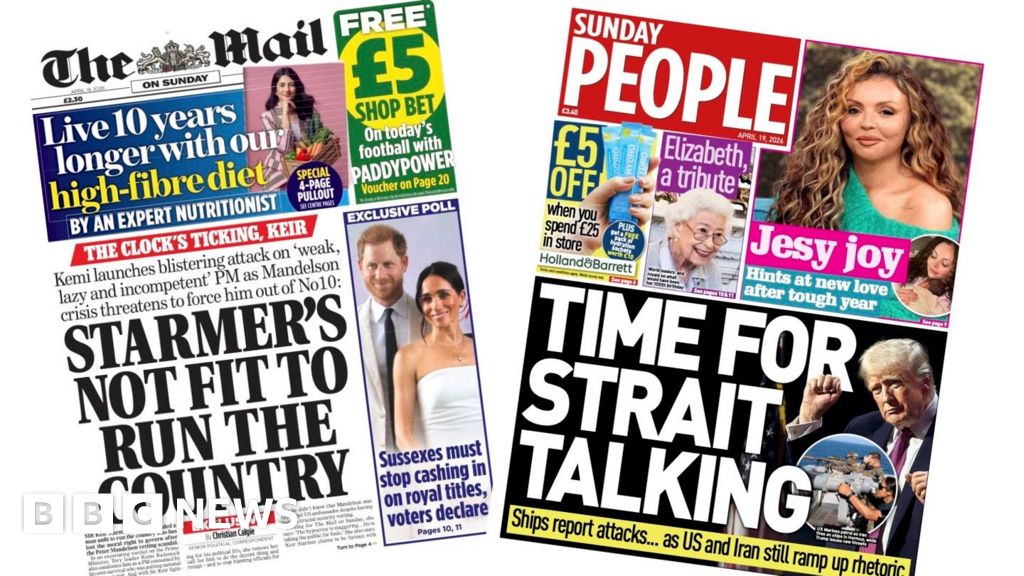
UK front pages are dominated by criticism of Prime Minister Keir Starmer over the handling of Lord Mandelson's US ambassador vetting, with claims senior officials knew weeks before the issue became public. Separately, reports highlight renewed tension in the Strait of Hormuz after Iran's announcement on reopening the waterway, while the Observer flags concerns that unregulated AI is contributing to a new mental health crisis. The piece is broadly political and geopolitical in nature, with limited direct market implications.
This is less a single-event political scandal than a slow-burn governance tax on the UK state: the market cares because repeated ambiguity around screening, accountability, and ministerial knowledge raises the probability of policy error, not just embarrassment. The immediate winner is the opposition narrative, but the tradable consequence is a modest widening of the UK political risk premium, which can bleed into sterling, domestic cyclicals, and any asset priced on smooth policy execution over the next 1-3 months.
The bigger second-order issue is institutional bandwidth. If the administration is forced into a prolonged defensive posture, it has less room to manage harder files like legacy legislation, defense procurement, and foreign policy coordination. That tends to delay decision-making, which is bearish for UK small caps and defense-adjacent names with government exposure, while favoring multinationals with non-UK revenue streams and dollar earnings.
The Strait of Hormuz angle is the cleaner market catalyst. Even if disruption proves temporary, the market will price tail risk immediately: shipping, tanker insurance, and energy volatility should react faster than physical supply. The setup favors owning convexity rather than outright direction because the probability of a short-lived escalation is materially higher than a prolonged closure; in other words, the best expression is via options or relative-value trades, not leveraged cash beta.
On AI regulation, the newsletter-style focus on chatbot harm is a reminder that consumer AI monetization could face a regulatory lag, especially in the UK/EU, but the first-order equity impact is usually multiple compression rather than revenue loss. Consensus still underestimates how quickly headline risk can shift from large-cap platforms to app-layer and unprofitable AI names if policymakers start linking AI to mental-health harms.
AI-powered research, real-time alerts, and portfolio analytics for institutional investors.
Request TrialOverall Sentiment
mildly negative
Sentiment Score
-0.20
