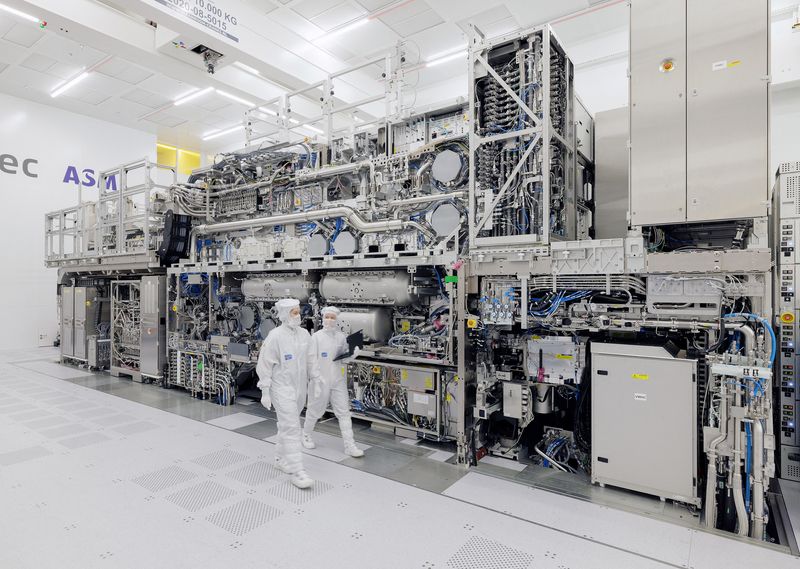
UBS reiterated a Buy on ASML and raised its price target to €1,900, citing capacity still above demand, rising memory lithography share, and an unfinished High NA adoption story. The firm lifted 2027 EUV revenue growth estimates to 37% YoY from 26% and 2028 to 10% from -1%, while projecting foundry/logic growth of 34% in 2027 and 18% in 2028. UBS also sees EUV capacity potentially exceeding 100 units in 2027 versus more than 80 previously communicated, supporting a more constructive outlook for ASML.
The setup is less about a one-quarter earnings beat and more about a multi-year pricing reset in lithography intensity. If capacity truly expands faster than consensus while demand remains sticky, ASML’s mix shifts toward higher-margin system shipments, but the bigger second-order effect is that wafer-fab equipment budgets stay elevated longer than the market expects, keeping the entire semi capex complex supported into 2027-2028. That argues for a broader read-through to upstream precision optics, stages, and industrial metrology vendors, while reducing the odds that chip-equipment multiples mean-revert quickly.
The key mispricing is not just units, but throughput. A higher theoretical EUV ceiling combined with faster shipment cadence compresses lead times and effectively pulls forward recognition, which can force buy-side models to keep stepping up revenue into a period when many are still modeling normalization. The beneficiaries are the most capacity-constrained end markets first: advanced logic and HBM-related memory, then adjacent suppliers tied to high-precision subcomponents. The main loser is any narrative that capex intensity will plateau as soon as near-term AI foundry bottlenecks ease; this looks more like a rolling constraint cycle than a peak.
Risk is mostly timing rather than thesis. Over the next 1-3 months, the stock can still wobble if bookings or shipment timing disappoints, because the market is already rewarding the “AI tollbooth” franchise with a premium multiple. Over the next 12-24 months, the main reversal risk is a demand pause in foundry/logic if TSMC or Samsung defer new nodes, or if memory tightness resolves faster than expected and the lithography intensity uplift fails to materialize. The more interesting contrarian point is that the stock may be under-owned not because the story is unknown, but because investors are still valuing it as a cyclical toolmaker rather than a duration asset on secular process complexity.
AI-powered research, real-time alerts, and portfolio analytics for institutional investors.
Request DemoOverall Sentiment
strongly positive
Sentiment Score
0.70
Ticker Sentiment
