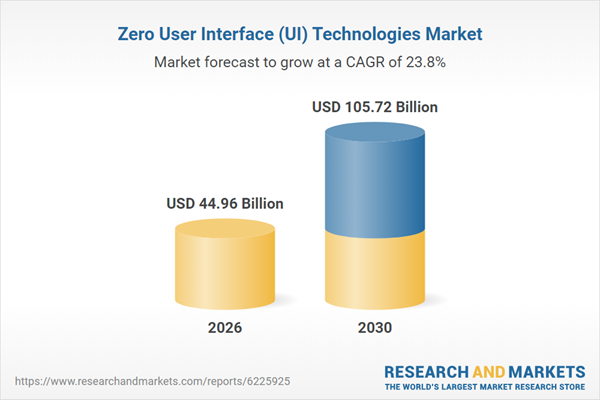
ResearchAndMarkets added a report on the global zero UI technologies market, projecting growth from $36.23B in 2025 to $105.72B by 2030 (23% CAGR). The update is constructive for the sector narrative but provides no company-specific catalysts or price-moving details.
This reads as a narrative signal, not a fundable catalyst: the market is being told the interface layer is changing, but monetization still has to prove out in product metrics. If the interaction model shifts from screens to agents/voice, the first dollars migrate to compute, sensors, connectivity, and device ecosystems—not to standalone UI software. That favors semis and platform owners with default distribution (NVDA, QCOM, AAPL, MSFT, GOOGL) while pressuring any software exposure whose moat depends on user attention, clicks, or workflow lock-in.
The 1-3 month risk is that this theme gets bought on AI beta alone and then fades because there is no hard earnings bridge. The more durable 6-18 month effect is margin structure: zero-UI experiences are inference-heavy, so whoever subsidizes those interactions could see gross margin dilution before pricing power catches up. That makes cloud providers and consumer platforms the gatekeepers; app-layer vendors may see their UI differentiation commoditized unless they can own the agent, not just integrate with it.
Contrarian view: consensus is likely overestimating the breadth of the TAM and underestimating adoption friction. Privacy, latency, battery life, and error tolerance are still real blockers, so a lot of this spend may simply repackage existing mobile/PC budgets rather than create new demand. The thesis is falsified if assistant usage does not show up in device attach rates, query share, or cloud inference revenue over the next two earnings cycles.
AI-powered research, real-time alerts, and portfolio analytics for institutional investors.
Request DemoOverall Sentiment
mildly positive
Sentiment Score
0.25
