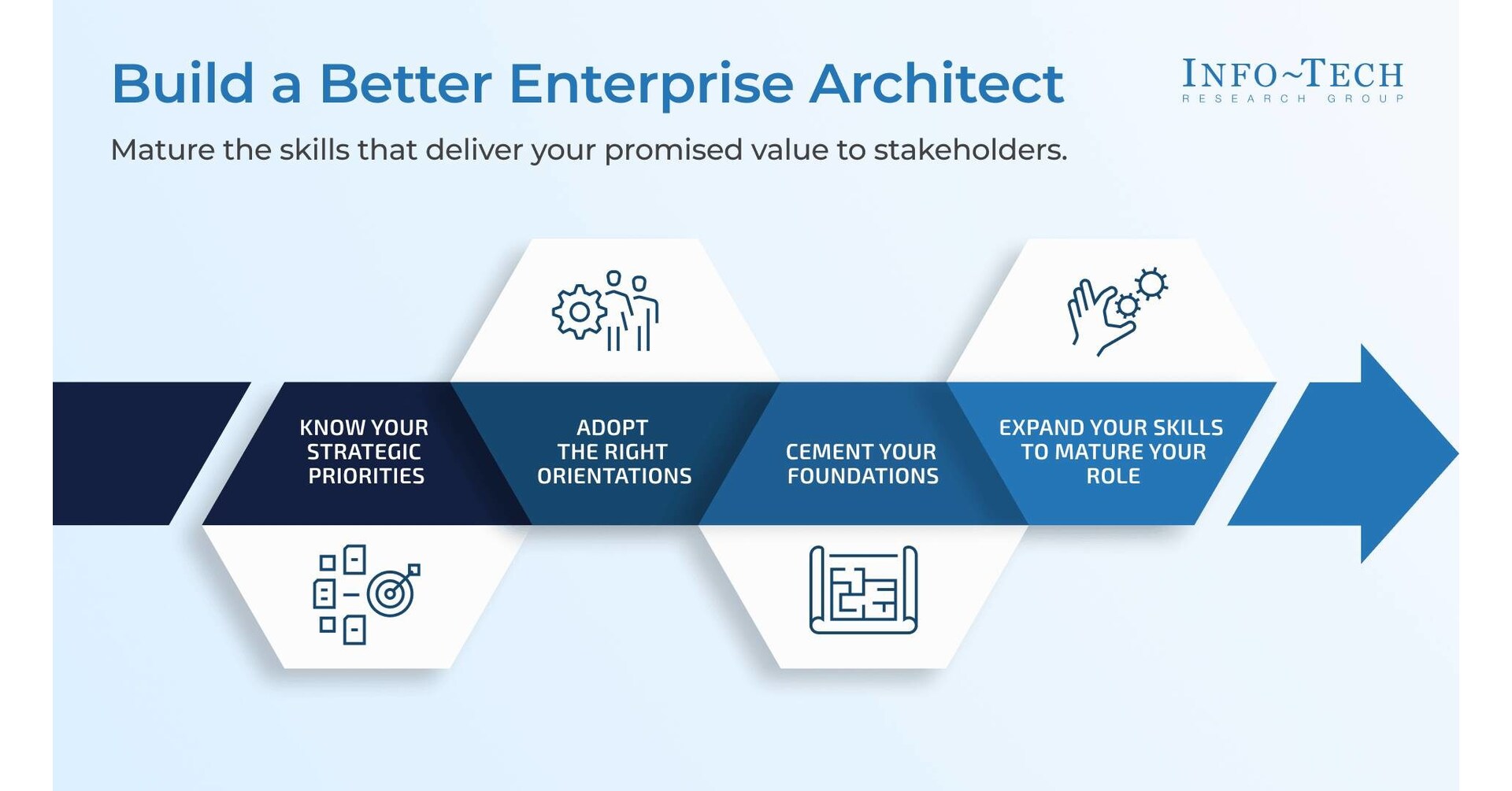
Info-Tech Research Group says many organizations struggle to define enterprise architect (EA) roles, leading to weaker credibility, stalled momentum, and poor business alignment despite continued EA investment. The firm’s blueprint, “Build a Better Enterprise Architect,” recommends a three-phase approach—(1) craft a context-specific EA role anchored to outcomes, (2) assess/prioritize EA skills by orientation, and (3) set SMART objectives with measurable metrics via templates for milestone roadmaps. Overall, the news is advisory/benchmarking in nature with limited direct financial market impact.
This is not a direct revenue event; it is a procurement/operating-model signal. The real implication is that EA spend is getting pulled from “soft” advisory narrative toward measurable workflow and governance tooling, which should incrementally favor platform vendors that can prove decision traceability, skill tracking, and portfolio visibility. In practice, that is more supportive of SAP/LeanIX-style architecture tooling and ServiceNow-adjacent workflow use cases than of standalone training/content vendors whose value proposition depends on vague maturity uplift.
The second-order loser is the generic IT services layer that monetizes ambiguous architecture work by headcount. If CIOs formalize role scope and SMART metrics, some EA activity gets standardized, automated, or pushed into PMO/enterprise platform teams, which caps billable advisory hours and makes it easier to benchmark away premium consulting rates. That effect would show up first in 1-3 month budget cycles and only later in 6-18 month hiring trends; there is no meaningful day-one catalyst here.
Contrarian view: the market may dismiss this as organizational hygiene, but the budget consequence can be real because anything that improves measurability usually precedes scrutiny. Still, the signal is too small to force a trade in the named tickers; the thesis only becomes investable if earnings commentary or procurement data show EA-tool attachment and consulting-hours displacement. Falsifiers: continued flat EA tool spend, no change in architect headcount, or management explicitly saying EA remains a low-priority governance function.
AI-powered research, real-time alerts, and portfolio analytics for institutional investors.
Request DemoOverall Sentiment
neutral
Sentiment Score
-0.05
Ticker Sentiment
