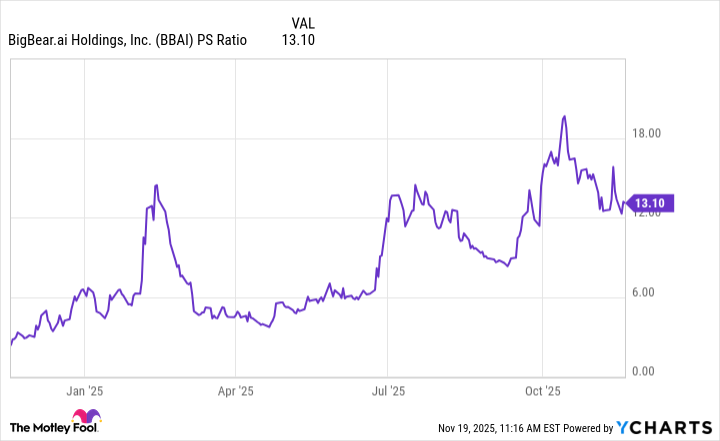
BigBear.ai shares trade around $5.40 (up ~160% over 12 months but down ~40% from an October peak and well off the $10.36 52-week high) after federal spending cuts dented demand: revenue fell 18% YoY to $32.5M in Q2 and 20% YoY to $33.1M in Q3, while Q3 operating loss widened to $21.9M from $10.5M a year earlier. The company has a strong balance sheet (total assets $919.8M, liabilities $309.7M, cash/equivalents/investments $715M, total debt $142M) and projects full-year sales of $125M–$140M with $100.4M reported through nine months; it is acquiring Ask Sage (expected early 2026) — a secure generative-AI platform with ~160,000 government teams and on track for ~$25M ARR — but valuation (P/S) remains elevated, and the article advises waiting for cheaper entry or improved quarters.
Market structure: Federal-demand weakness reallocates share toward larger, diversified cybersecurity and cloud infrastructure vendors with broader commercial go-to-market; small-cap, government-dependent AI/security specialists will face pricing pressure and longer procurement cycles. This favors vendors with predictable S&M and enterprise renewals and increases implied vol in small-cap cybersecurity equities, while credit spreads of similarly levered peers likely widen as risk premia rise.
Risk assessment: Key tail risks include abrupt further cuts to discretionary federal programs, a failed integration or goodwill impairment from the announced acquisition, and new regulation on generative AI that restricts government contracting — any of which could materially reduce revenue visibility within 6–18 months. Near-term catalysts are upcoming quarterly prints and defense appropriations votes (next 30–90 days); medium-term drivers are contract awards and the acquisition closing timeline.
Trade implications: Favor short-idiosyncratic exposure to the company vs. long exposure to large-cap cyber (e.g., CRWD, PANW) to capture relative strength; use partial-sized positions (1–2% NAV) and volatility-defined option structures to limit downside. Rotate 3–6% of growth exposure into NVDA/large-cap AI infrastructure and high-quality cyber names, and avoid adding leverage into the small-cap AI/cyber cohort until two consecutive quarters show organic margin improvement.
Contrarian angles: Market may be discounting too much given a strong cash buffer and runway — a distressed-price entry could pay if government spend normalizes or acquisition synergies crystallize. Conversely, consensus underestimates integration execution risk; consider asymmetric option structures to capture both outcomes rather than outright large directional bets.
AI-powered research, real-time alerts, and portfolio analytics for institutional investors.
Request DemoOverall Sentiment
moderately negative
Sentiment Score
-0.45
Ticker Sentiment
