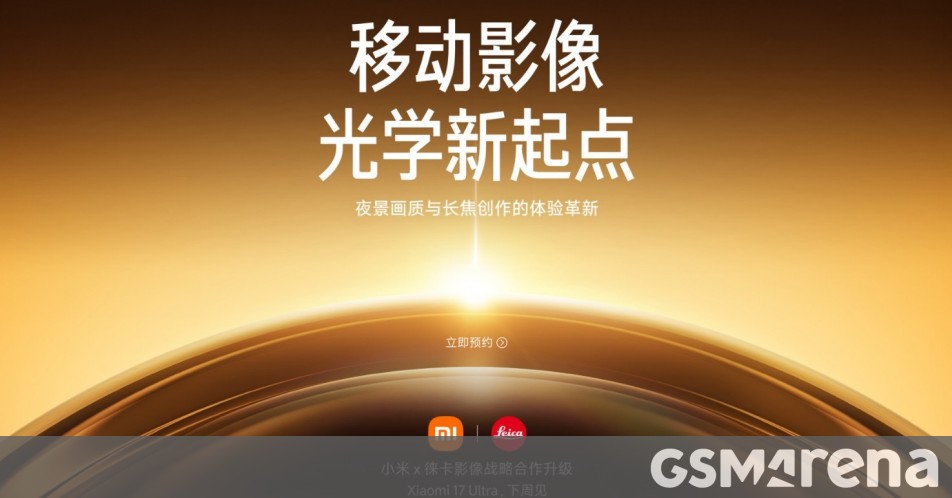
Xiaomi confirmed the imminent launch of the Xiaomi 17 Ultra in China next week (no exact date) and announced a Leica collaboration, highlighting expected telephoto and night‑time imaging improvements. The model is FCC‑certified and is rumored to feature a Snapdragon 8 Elite Gen 5 and a 1‑inch primary sensor, signaling a potential competitive flagship push that could influence Xiaomi's positioning against Samsung and Apple and warrants monitoring for international rollout and demand implications.
Market structure: Xiaomi’s confirmed Xiaomi 17 Ultra (Leica, Snapdragon 8 Elite Gen5, 1" sensor) directly benefits Xiaomi (1810.HK), Qualcomm (QCOM) and large sensor/optics suppliers (e.g., SONY 6758.T) by supporting ASPs in the premium Android tier; Apple (AAPL) faces incremental pricing/feature pressure in China but not an immediate earnings shock. Competitive dynamics: a successful Ultra launch can expand Xiaomi’s high-end share by 1–3 percentage points in China over 6–12 months, forcing rivals to discount or subsidize telephoto/sensor-equipped models and compress mid-cycle Android margins by 50–150bps. Supply/demand: FCC certification signals intent to export — expect near-term demand concentration in China then phased international demand; watch component lead times (camera modules, SoC) for signs of supply tightness that could cap volumes. Cross-asset: stronger Xiaomi sales would modestly support CNY and EM equities, lift QCOM and 6758.T equity/option vols, and have negligible sovereign bond impact; implied vol spikes around launch create short-term option opportunities.
Risk assessment: Tail risks include US export restrictions on advanced imaging/chips or negative Leica licensing disputes that could reduce international rollouts; estimate <10% probability but high impact. Time horizons: immediate (days) — rumor-driven vol and option premium; short-term (weeks–3 months) — reviews/sales and retail sell-through data; long-term (6–24 months) — market-share shift and margin trends. Hidden dependencies: carrier partnerships, Google services availability in markets, and Leica marketing share — weaknesses here can limit international adoption. Catalysts: official launch date, DxOMark/major reviews (0–14 days post-launch), first-month sell-through data and FCC import records.
Trade implications: Direct plays — consider a 2–3% allocation long QCOM (exposure to Snapdragon) and a 1–2% tactical long to 1810.HK around launch; buy 3–6 month QCOM call spreads (e.g., 10–20% OTM) to cap capital. Pair trade — long 1810.HK (or XIACF ADR) vs short AAPL hedge (0.5–1% portfolio) to express share-shift risk in China over 3–6 months; size conservatively. Options strategies — buy straddles on 1810.HK or QCOM 7–14 days before launch if implied vol < historical 90-day vol +25%, else sell premium post-review. Sector rotation — overweight China consumer electronics suppliers and optics (SONY) and underweight premium US handset cyclicals if Xiaomi pricing is aggressive. Entry/exit — enter 3–7 days pre-launch, take profits at +15% or within 30 days of strong sell-through, stop-loss at -10% or on negative flagship reviews.
Contrarian angles: Consensus underestimates Xiaomi’s capacity to monetize Leica branding at premium prices — scenario where Xiaomi captures 2–4% global flagship share in 12 months is plausible and underpriced. Conversely, consensus may be underestimating margin erosion from Leica fees and expensive sensors; a materially higher bill-of-materials could force Xiaomi to choose share vs margin and compress suppliers’ leverage. Historical parallel: Huawei’s camera-first strategy won share but was later neutralized by sanctions — regulatory/regionalization risk could repeat. Unintended consequence: a successful Xiaomi Ultra could catalyze price-driven feature arms race, compressing OEM margins industry-wide by 100–200bps over 12 months, which would favor component suppliers over handset OEMs.
AI-powered research, real-time alerts, and portfolio analytics for institutional investors.
Request DemoOverall Sentiment
neutral
Sentiment Score
0.10
Ticker Sentiment
