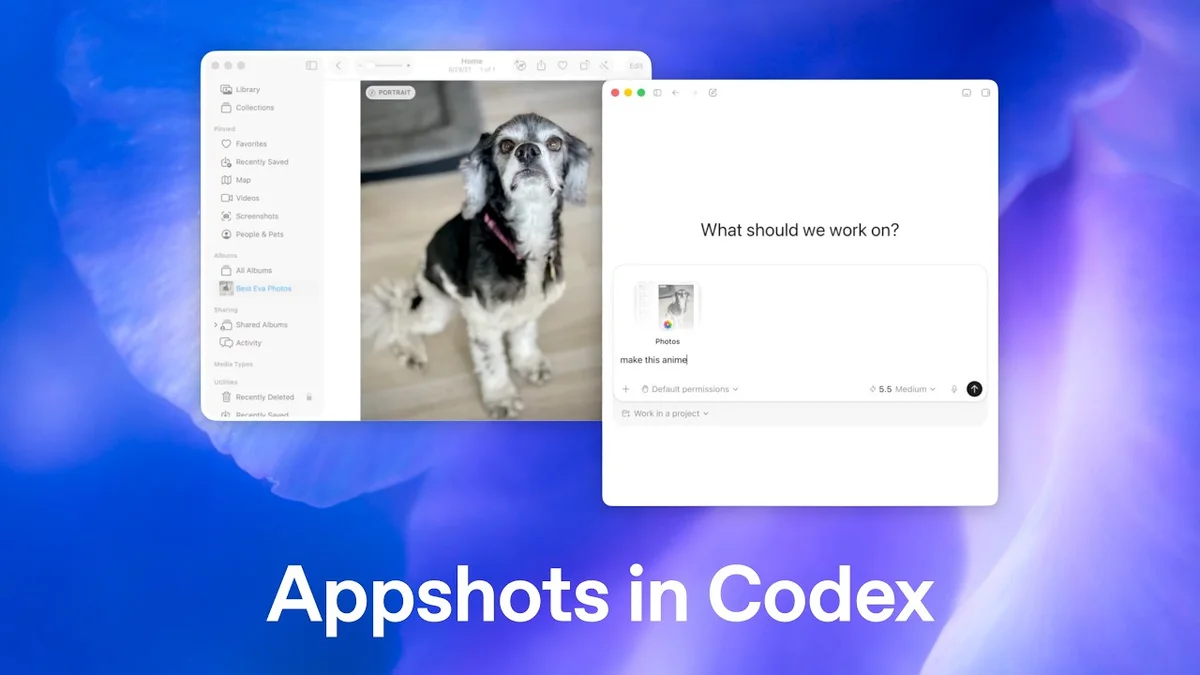
OpenAI's Codex unveiled Appshots, a new feature that lets users share what is on their screen so the model can interpret and act on visual context across apps. Demonstrations included extracting event details from email to add to a calendar, modifying photos, generating a press release from Figma mockups, and cleaning up a fundraiser brainstorm into a Google Doc. The update underscores improved AI workflow integration, but it is primarily a product feature announcement with limited near-term market impact.
This is less about a feature launch than about a distribution wedge: if AI can reliably act on what is on the screen, the product moves from “chat” to “workflow middleware.” That increases switching costs because the model no longer just answers questions; it sits inside the user’s active context and can ingest the messy, unstructured inputs that dominate real knowledge work. The second-order effect is that the best-positioned incumbents are not pure AI apps but the software environments where screenshots, mockups, and documents already live.
For FIG, the near-term read-through is more strategic than immediate revenue-positive. Faster AI-to-design workflow could expand seat usage and shorten iteration cycles, but it also raises the odds that simple design-generation tasks get commoditized and priced into lower ARPU over time. The more important question is whether integration into the design stack makes FIG the default source of truth for AI agents; if yes, this is a net-positive for retention and expansion, but if not, Appshots-like tools become a leakage vector to adjacent productivity suites.
The consensus may be underestimating how quickly this shifts competitive moats from model quality to interface ownership. Over the next 3-6 months, the market will likely reward companies that can show measurable workflow acceleration rather than raw demo quality; over 12+ months, the risk is that AI-enabled screen understanding compresses differentiation across point solutions. The tail risk is regulatory/privacy friction around screen capture and enterprise data governance, which could slow adoption in corporate environments even if consumer usage spikes.
The clean trade is to own the platform beneficiaries and fade single-feature expectations in adjacent workflow names. The setup favors a pair where you are long the software layer that controls the creative workflow and short a broader SaaS basket most exposed to AI-driven feature parity. In the options market, upside should be treated as a series of discrete catalyst-driven rerates, not a straight-line compounding story, so call spreads are preferable to outright long-delta exposure.
AI-powered research, real-time alerts, and portfolio analytics for institutional investors.
Request DemoOverall Sentiment
mildly positive
Sentiment Score
0.35
Ticker Sentiment
