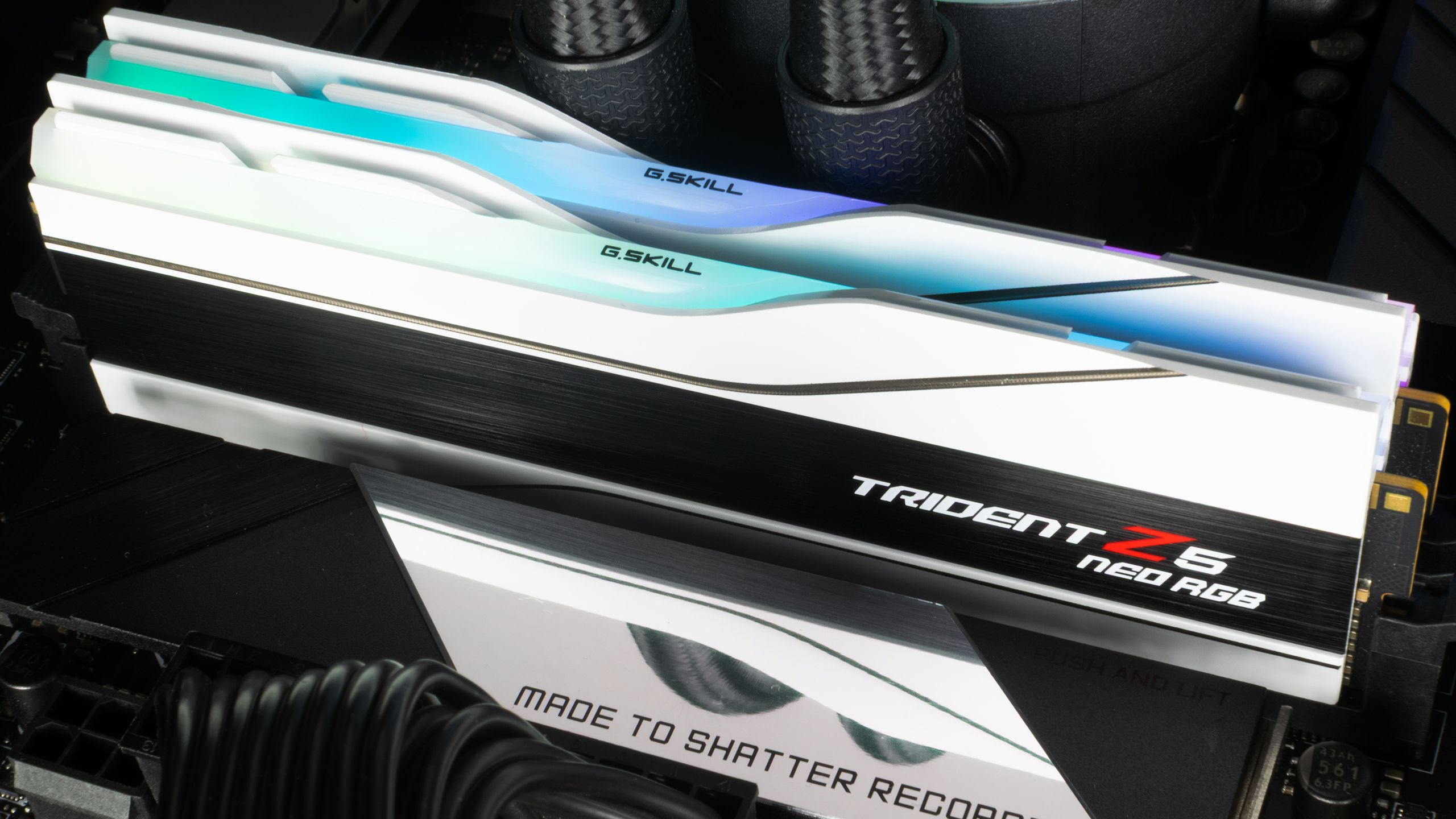
AI-driven demand for memory and storage has driven a sharp price surge in DDR5 RAM: a 64GB G.Skill Trident Z5 Neo 6000 MT/s kit is listed at $599.99 (Black Friday price from $640), after regularly trading near $205–$220 earlier this year and jumping from $220 on Sept. 20 to $640 (an ~190% increase) in roughly two months. Industry commentary warns DRAM and NAND constraints could persist into 2026, producing two-year backorders for large-capacity HDDs and heightened demand for QLC SSDs, which will pressure consumer hardware makers and retailers while advantaging suppliers prioritized by enterprise AI workloads.
Market structure: Acute DRAM/NAND scarcity driven by AI server buildouts benefits memory suppliers and vertically integrated cloud/AI incumbents that can secure allocations (Micron (MU), Samsung, SK Hynix); consumer OEMs (Intel, AMD-powered PC OEMs) and retail channels face margin pressure and product deflation in volumes. Pricing power has shifted to wafer-level manufacturers — expect ASPs to remain elevated (+100–200% YTD observed) through 2025 with meaningful revenue upside for suppliers that can keep yields high and FAB utilization >90%.
Risk assessment: Tail risks include rapid capex response by DRAM vendors (which could normalize prices faster than consensus — 12–24 month lead), export/regulatory restrictions on AI hardware, or demand destruction if AI projects optimize memory use; near-term (days–weeks) volatility will track spot-DRAM indices, medium-term (3–12 months) driven by quarterly capex/guidance, long-term (2026–2027) normalization if capacity ramps. Hidden dependencies: GPU availability, NAND/SSD shortage feedback loops, and enterprise procurement cycles — monitor DRAM spot price moves >20% month-over-month as a catalyst.
Trade implications: Favor long exposure to primary memory producers (MU or SSNLF ADRs) sized 2–4% portfolio with a 6–12 month horizon; hedge or underweight consumer CPU/desktop exposure (reduce INTC/AMD delta exposure by 30–50% vs index) and overweight cloud names (MSFT, AMZN, GOOG) by 2–3% to capture revenue upside from AI services. Use options: buy MU 9–12 month call spreads (25–40% OTM) or a 6–9 month long-call (theta-light) to limit capital; consider pair trade long MU vs short INTC (notional-neutral) to capture memory ASP vs PC-margin dispersion.
Contrarian angles: Consensus underestimates cyclical reversals — history (DRAM 2017–2019) shows 18–30 month booms revert sharply; prices could be overshooting current demand growth by 20–40% if inventory rebuild accelerates. Unintended consequence: persistently high memory costs may force AI firms into architectural efficiency (reducing per-model memory needs), capping long-term DRAM demand growth; therefore trim longs on >35% run-up or if spot-DRAM index drops >25% within 60 days.
AI-powered research, real-time alerts, and portfolio analytics for institutional investors.
Request DemoOverall Sentiment
moderately negative
Sentiment Score
-0.50
Ticker Sentiment
