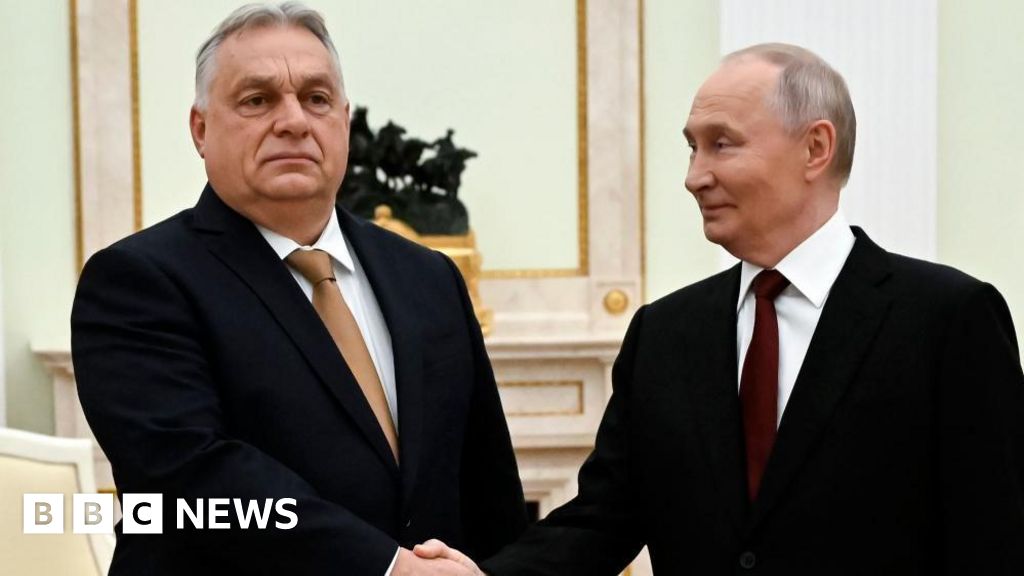
Hungarian Prime Minister Viktor Orban met Vladimir Putin in Moscow and secured guaranteed supplies of Russian oil and gas and agreement to continue construction of the Paks nuclear plant, while proposing Budapest as a potential venue for a Russia–US summit. Hungary currently sources over 80% of its oil and gas and 100% of its nuclear fuel from Russia, contributing roughly $5bn annually to the Russian budget; Orban also obtained a US exemption on Russian fuel supplies contingent on his remaining in power. The visit intensifies EU friction over sanctions and energy policy as Hungary resists EU plans to end Russian energy imports by 2027, raising regional political and energy-supply risk ahead of Hungarian parliamentary elections in April.
Market structure: Orban’s Moscow visit entrenches a bifurcated European energy market — Hungary (and possibly Serbia/Slovakia) is likely to secure continued Russian pipeline/nuclear supplies near-term while simultaneously signing US LNG/uranium deals. Expect localized pricing power for Russian suppliers on pipeline oil/gas to Hungary but incremental demand for LNG shipping and US suppliers; this is material to ~€3–5bn regional flows (Hungary ≈$5bn/yr to Russia) not to whole-EU balances. Energy commodity volatility (TTF, Brent, power) will rise into the Apr 2025 Hungarian election and EU 2027 sanction deadlines.
Risk assessment: Key tail risks — abrupt revocation of US exemptions if Orban loses (April 2025) causing a >15–25% spike in Hungarian gas procurement costs; or an EU punitive response widening Hungary 10y spreads by +100–300bp. Hidden dependency: US supply/waivers are explicitly conditioned on political continuity; second-order risk is regional gas routing changes if Budapest becomes an energy transit hub. Catalysts: Hungarian election polls (weekly), EU votes on sanctions/funding (next 6–18 months), and winter storage levels (Oct–Mar).
Trade implications: Tactical plays include directional gas volatility exposure (long ICE TTF 3–6 month call spreads), selective LNG shipping/terminal exposure (GLNG, LNG), and political/sovereign hedges (short HUF via forwards or buy Hungary CDS). Use defense/European security names (RHM.DE, RTX) as geopolitical hedges for 6–18 months. Size positioning to 1–3% per idea and set stop-losses at 30% of notional or specific event triggers (see decisions).
Contrarian angle: Consensus assumes stable Russian flows to Hungary; that underprices the election conditionality — if Orban loses, Hungary rapidly pivots to US LNG/uranium and needs 6–12 months of incremental imports, pushing regional TTF and shipping rates materially higher. Conversely, a pro-Orban outcome could create a mini “Russian exemption corridor” compressing EU spreads but raising idiosyncratic political risk premiums; both outcomes create tradable dispersion.
AI-powered research, real-time alerts, and portfolio analytics for institutional investors.
Request DemoOverall Sentiment
mildly negative
Sentiment Score
-0.25
