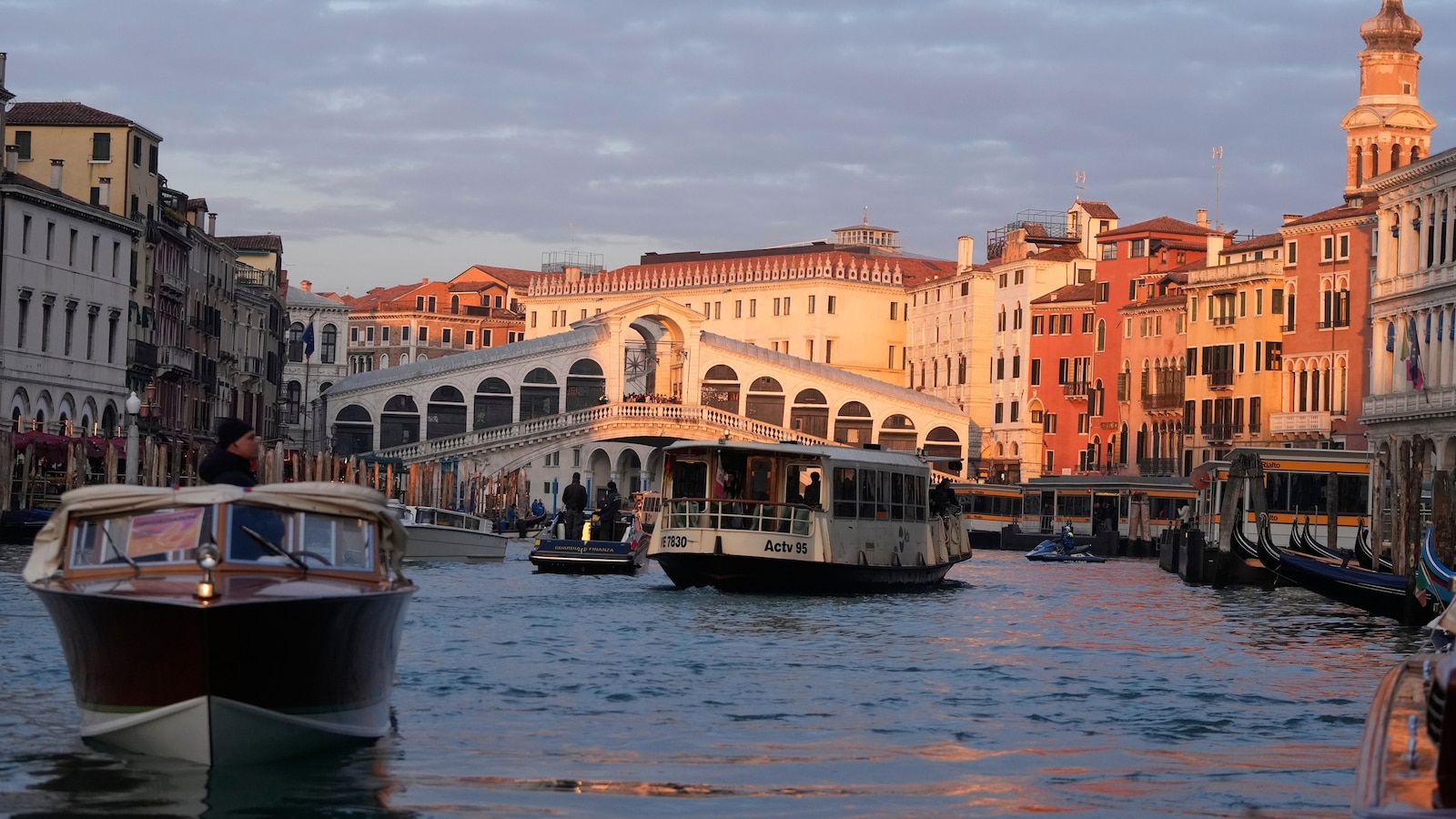
Venice faces rising flood risk as researchers warn current MOSE barriers may only protect against up to 1.25 meters of sea level rise, a threshold likely exceeded by 2300 even under a low-emissions scenario. Proposed defenses include ring dikes costing $600 million to $5.3 billion, a super levee at more than $35 billion, or eventual relocation at up to $118 billion. The study underscores escalating climate adaptation costs and long-term infrastructure risk for the historic city.
The key market implication is not Venice-specific tourism shock, but the repricing of long-dated municipal adaptation capex across Europe. Once an iconic city is framed as requiring multi-decade engineering rather than periodic remediation, it pushes investors toward beneficiaries of flood defense, geotechnical engineering, coastal materials, and public-sector resilience funding. That creates a slow-burn demand tail for contractors with marine works capability, while also increasing pressure on Italian fiscal planning and on insurers/ reinsurers exposed to repeated attritional flood claims.
The second-order effect is that the problem compounds on financing terms: the more frequently barriers are deployed, the more likely Venice becomes a recurring maintenance and operating expense story rather than a one-time project. That favors firms selling recurring services, sensors, pumps, and infrastructure software over pure-build names, because political capital for mega-projects is usually weaker than for staged, modular solutions. It also widens the gap between “asset protection” spend and “asset relocation” spend, which is a useful lens for infrastructure portfolios: the former is investable now, the latter is mostly a policy option with a very long optionality horizon.
For public markets, the trade is less about a single catalyst and more about an accelerating global template: other low-lying heritage and coastal cities will now face the same cost stack, supporting a multi-year rerating of flood-defense supply chains. The contrarian risk is that this remains a headline story without near-term procurement conversion; budgets, permitting, and heritage constraints can delay orders by years. So the best expression is through companies already levered to existing infrastructure and water-management capex, not speculative turnaround names reliant on new Venice contracts.
Bottom line: the near-term sentiment is mildly negative for travel and local economic activity, but the investable opportunity sits in the “adaptation economy,” where repeated climate events create a durable backlog rather than a single rebuild cycle. The highest-conviction setup is to own diversified environmental infrastructure winners and fade businesses that depend on uninterrupted waterfront operations. If climate adaptation spending becomes embedded in EU infrastructure policy over the next 12-24 months, this can become a meaningful thematic tailwind rather than a one-off news item.
AI-powered research, real-time alerts, and portfolio analytics for institutional investors.
Request TrialOverall Sentiment
mildly negative
Sentiment Score
-0.25
