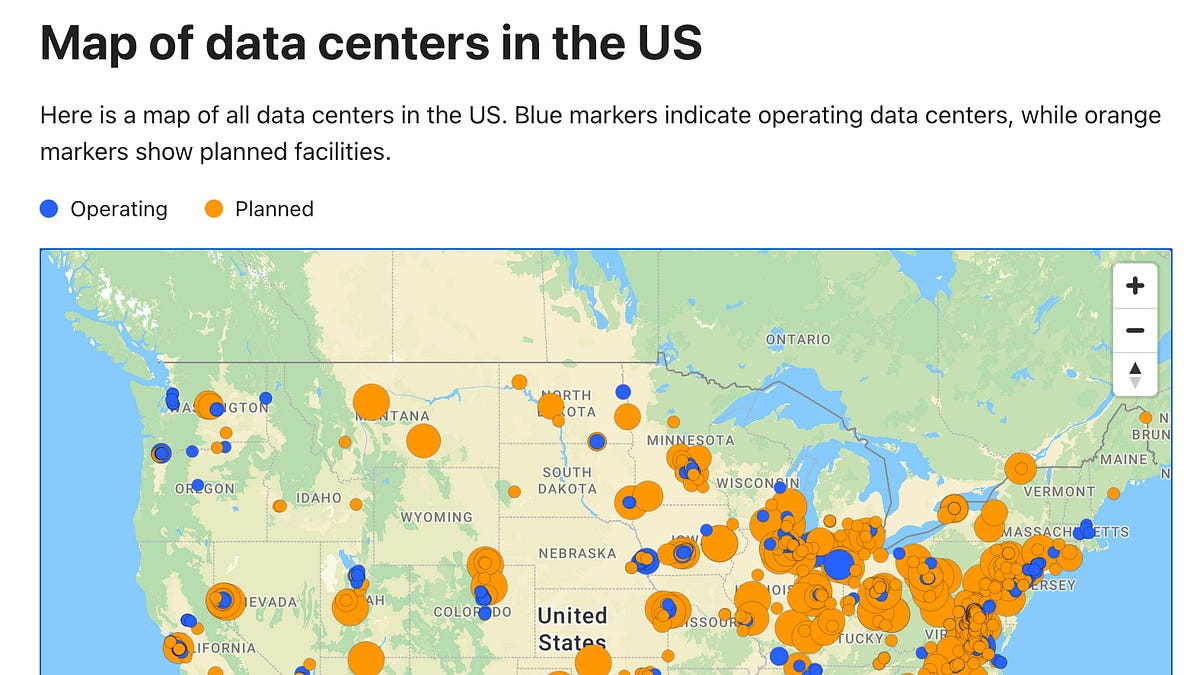
The article argues that anti-data center campaigns are becoming a key vehicle for democratic governance of AI, with local opposition emerging from working-class, indigenous, and community groups rather than just affluent NIMBYs. It highlights ongoing fights and bans in places like Monterey Park, the Seminole Nation, San Marcos, and Coweta, while criticizing the rush by Oracle, OpenAI, Google, Meta, and others to expand AI infrastructure. The piece frames data center moratoria and community resistance as a potential check on mass automation, surveillance, energy demand, and wealth concentration.
The market takeaway is not that AI demand is fading; it is that the path from demand to monetization is getting more politically expensive. The first-order risk is delay: local opposition, permitting friction, and utility scrutiny can push hyperscaler capex into longer-dated buckets, which compresses near-term revenue visibility for infrastructure vendors while leaving the strategic narrative intact. That usually hurts the highest-multiple beneficiaries first because their valuation assumes frictionless deployment and rapid take-rate expansion.
Second-order, the article points to a less obvious margin squeeze: if the AI buildout becomes a broader governance fight, buyers will increasingly demand concessions on power, water, labor, and community benefits. That can raise project costs even when projects proceed, shifting economics from software-like gross margins toward utility-like returns. ORCL is most exposed on sentiment because it sits closest to the public-facing flagship projects and the broader capex cycle; PLTR’s risk is more reputational and procurement-related, tied to surveillance/defense concerns rather than pure data-center siting.
The contrarian read is that this is not an anti-AI demand shock; it is a bargaining-shock. Public resistance may actually widen the eventual addressable market for regulated, slower, and more expensive AI deployment by forcing governance frameworks that legitimize the industry over time. That means any selloff in the AI complex on “moratorium” headlines is likely more tactical than structural unless it starts to impair cloud capex guidance or triggers utility-level constraints on power interconnects over the next 2-6 quarters.
AI-powered research, real-time alerts, and portfolio analytics for institutional investors.
Request DemoOverall Sentiment
neutral
Sentiment Score
0.00
Ticker Sentiment
