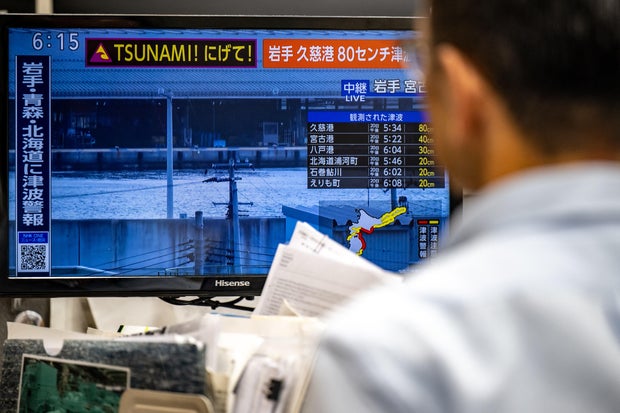
A magnitude 7.7 earthquake struck off Japan’s northern coast, triggering a tsunami alert that was later downgraded after waves peaked at about 2.6 feet and no damage or injuries were reported. More than 128,000 residents in northern prefectures received evacuation advisories, while nuclear plants and other critical facilities were said to be intact. Officials also issued a separate advisory flagging a 1% chance of a mega-quake in the next week, underscoring elevated regional risk.
The market impact is less about direct damage and more about optionality: Japan’s equity complex has a built-in “disaster discount” that tends to widen quickly on headline risk, even when physical losses prove limited. That creates a short-lived bid for safety-adjacent names and a temporary derating of domestic cyclicals, while exporters can outperform if the yen weakens on repatriation and defensive flows. The second-order issue is logistics: even without plant damage, ports, rail links, and coastal utilities can create 24-72 hour interruptions that ripple through semiconductor, auto, and precision manufacturing supply chains.
The bigger medium-term catalyst is not the quake itself but the renewed policy focus on coastal resilience, nuclear oversight, and emergency preparedness. That favors firms with exposure to retrofit, grid hardening, monitoring, and civil engineering, while increasing scrutiny on utilities with older coastal assets and insurers with Japan nat-cat exposure. Because the official nuclear status looks stable, any sustained move in power-linked equities would likely be a false start unless aftershocks or inspection delays reveal hidden downtime.
The contrarian read is that the advisory may prove more important for sentiment than fundamentals: the prior mega-quake warning likely makes investors overreact to a low-probability tail event. If no aftershock sequence emerges over the next 7-10 days, the trade should mean-revert quickly, especially in domestic banks, retailers, and transport operators that get sold mechanically on headline risk. The real tail risk is a multi-week inspection cycle that quietly hits industrial output without a dramatic damage headline, which would be the scenario to stay defensive on.
AI-powered research, real-time alerts, and portfolio analytics for institutional investors.
Request DemoOverall Sentiment
moderately negative
Sentiment Score
-0.35
