
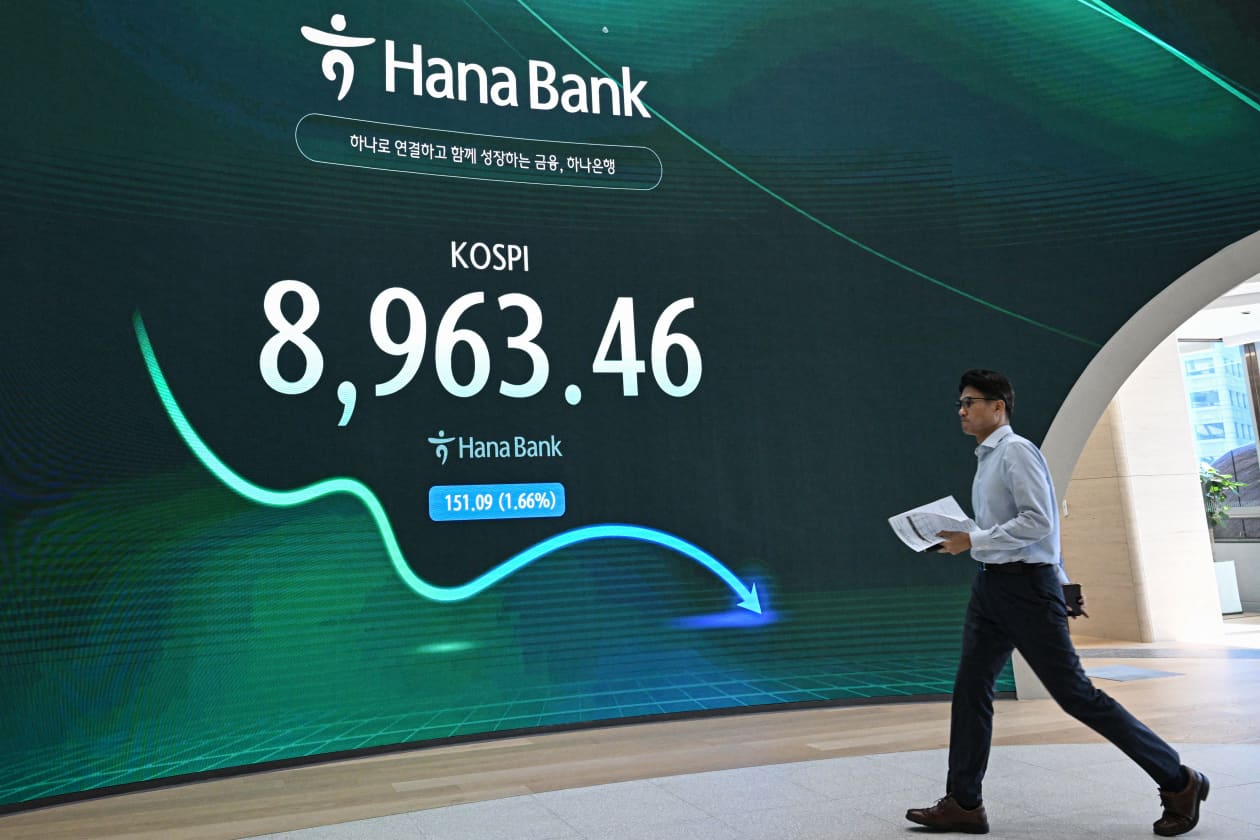
SK Hynix shares swung sharply, collapsing about 12% on Thursday after a near 9% jump on Wednesday, with prior volatility including a roughly +9% move and then a -11% session. The selloff occurred despite upbeat earnings and guidance for the broader semiconductor complex, citing solid updates from ASML and TSM over the prior 24 hours. Overall, momentum tied to AI optimism appears to be fading, keeping near-term trading risk elevated for SK Hynix.
The key move here is not a change in semiconductor end-demand, but a repricing of conviction: AI-linked memory names have become crowded momentum trades, so even good operating prints are now being sold when they fail to exceed the highest embedded expectations. That creates a self-reinforcing loop where hedge fund gross exposure and retail chasing amplify day-to-day swings, and implied volatility stays elevated even if the underlying earnings path is still constructive.
SK Hynix looks most vulnerable because its valuation is effectively a levered bet on sustained HBM scarcity and flawless execution. If hyperscaler budgets or HBM allocation normalizes even modestly, the multiple can compress faster than estimates move, while Samsung and Micron gain relative share if buyers diversify supply to reduce dependency risk. The second-order loser is any memory supply-chain name priced off peak AI enthusiasm; the winner is the broader, more diversified AI infrastructure complex where revenue visibility is less binary.
TSM should be a relative beneficiary of this fatigue because it monetizes AI demand without relying on a single memory cycle, so it can absorb a rotation out of speculative AI winners. Over 1-3 months, the important catalyst is whether upcoming capex commentary confirms that AI spend is still rising enough to justify current memory premiums; over 6-18 months, the risk is that supply catches up and HBM becomes a normal product line rather than a scarcity asset. The thesis is falsified if HBM pricing, utilization, or forward guidance re-accelerates enough to re-anchor the market around shortage economics rather than peak-cycle fears.
AI-powered research, real-time alerts, and portfolio analytics for institutional investors.
Overall Sentiment
mildly negative
Sentiment Score
-0.25
Ticker Sentiment
