
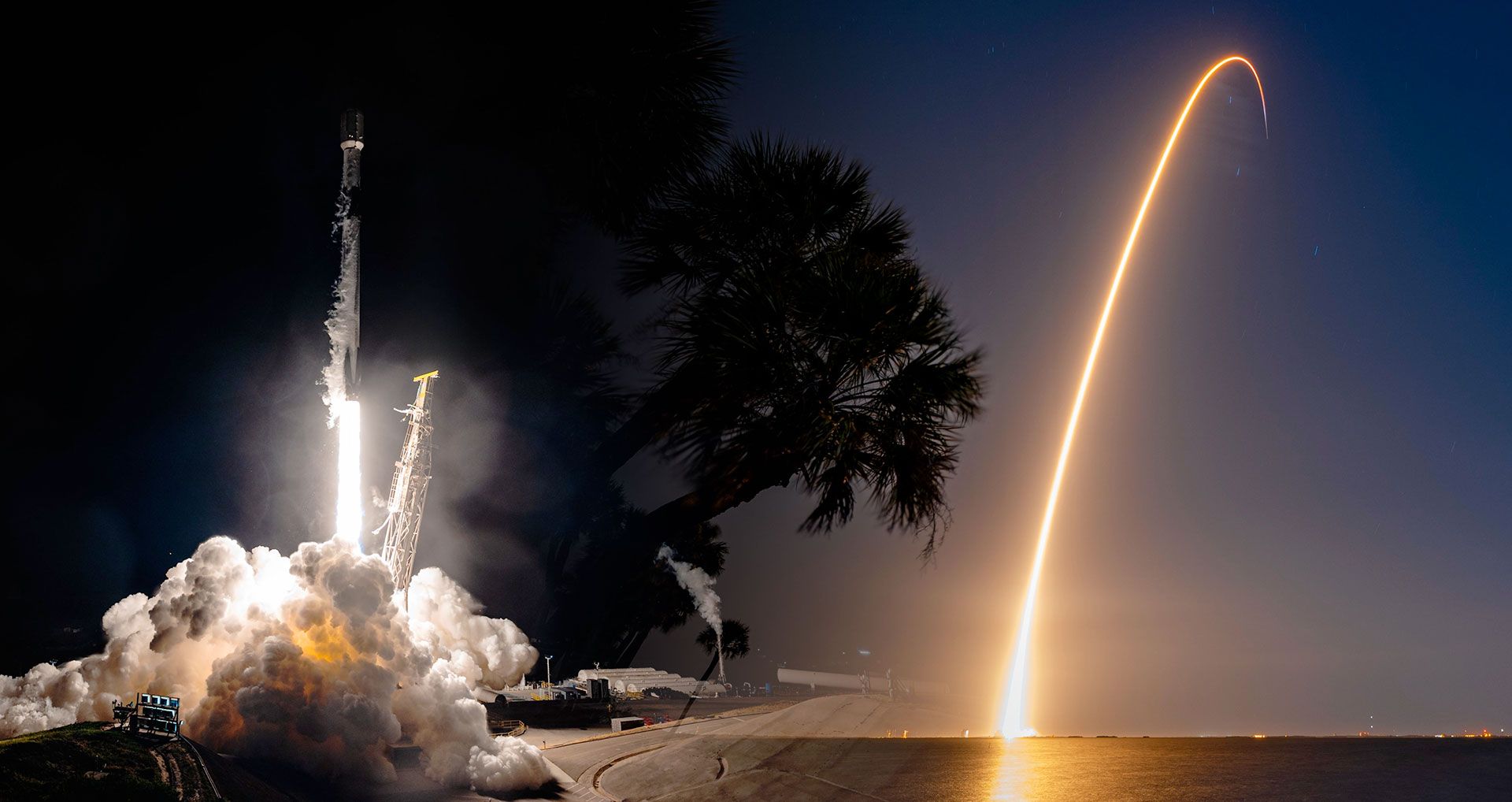
SpaceX executed two Falcon 9 Starlink launches on March 1, 2026: a 5:10 a.m. EST liftoff from Vandenberg deploying 25 satellites (Group 17-23) and a 9:56 p.m. EST launch from Cape Canaveral deploying 29 satellites (Group 10-41). Both first-stage boosters were recovered (booster 1082 on its 20th flight landed on Of Course I Still Love You; booster 1078 on its 26th flight landed on Just Read the Instructions), bringing the Starlink constellation to over 9,900 satellites and marking SpaceX's 27th launch of the year and 620th mission overall. The operations underscore continued high launch cadence and booster reusability, reinforcing execution risk reduction and rapid constellation growth.
Market structure: Repeated Falcon 9 Starlink lifts expand Starlink’s capacity (now >9,900 satellites) and lower marginal cost of LEO delivery—clear winners are LEO-native platforms (Starlink/private) and suppliers of mass-produced user terminals/antenna electronics. Losers are legacy GEO/MEO incumbents exposed to consumer and mobility segments (pricing pressure risk) and alternative launch providers losing pricing power. Increased LEO supply points to downward pressure on ARPUs unless end-market demand (rural, maritime, defense) grows >15–20% CAGR; expect satellite-equity dispersion and rising credit spreads for weaker operators within 3–12 months.
Risk assessment: Tail risks include stricter national-security export controls or spectrum reallocation within 6–18 months, catastrophic collision/debris that forces temporary de-orbiting and insurance losses, or a major Falcon 9 failure that delays launches and raises launch costs. Immediate-market risks (days) are PR/contract headlines; short-term (weeks–months) are quarterly subscriber disclosures; long-term (quarters–years) center on capex amortization and terminal unit economics. Hidden dependencies: government DoD/USG purchasing decisions, ground-terminal supply chains, and spectrum/licenses which can flip winner/loser status quickly.
Trade implications: Overweight suppliers of ground terminals, electronic components and defense primes that integrate LEO services; underweight pure-play consumer GEO operators and small-cap launch rivals. Volatility should rise in small-cap satellite names around quarterly subscriber/contract updates—use options to express views. Relative opportunities: long defensive L-band operators vs short consumer Ka/Ku incumbents.
Contrarian angles: Consensus assumes Starlink will simply displace GEO incumbents; miss is regulatory/frictional barriers that can protect incumbents (spectrum, gov contracts) and create a multi-tier market. Historical parallel: mobile-data capacity surges depressed ARPUs for years before new revenue tiers emerged—same could happen here, giving selective LEO-capacity owners pricing power later. Unintended consequence: rapid LEO densification raises debris/regulatory costs that advantage well-capitalized incumbents.
AI-powered research, real-time alerts, and portfolio analytics for institutional investors.
Request TrialOverall Sentiment
moderately positive
Sentiment Score
0.45
Ticker Sentiment
